DEI Mentoring Programs: The Complete Guide
Quick answer
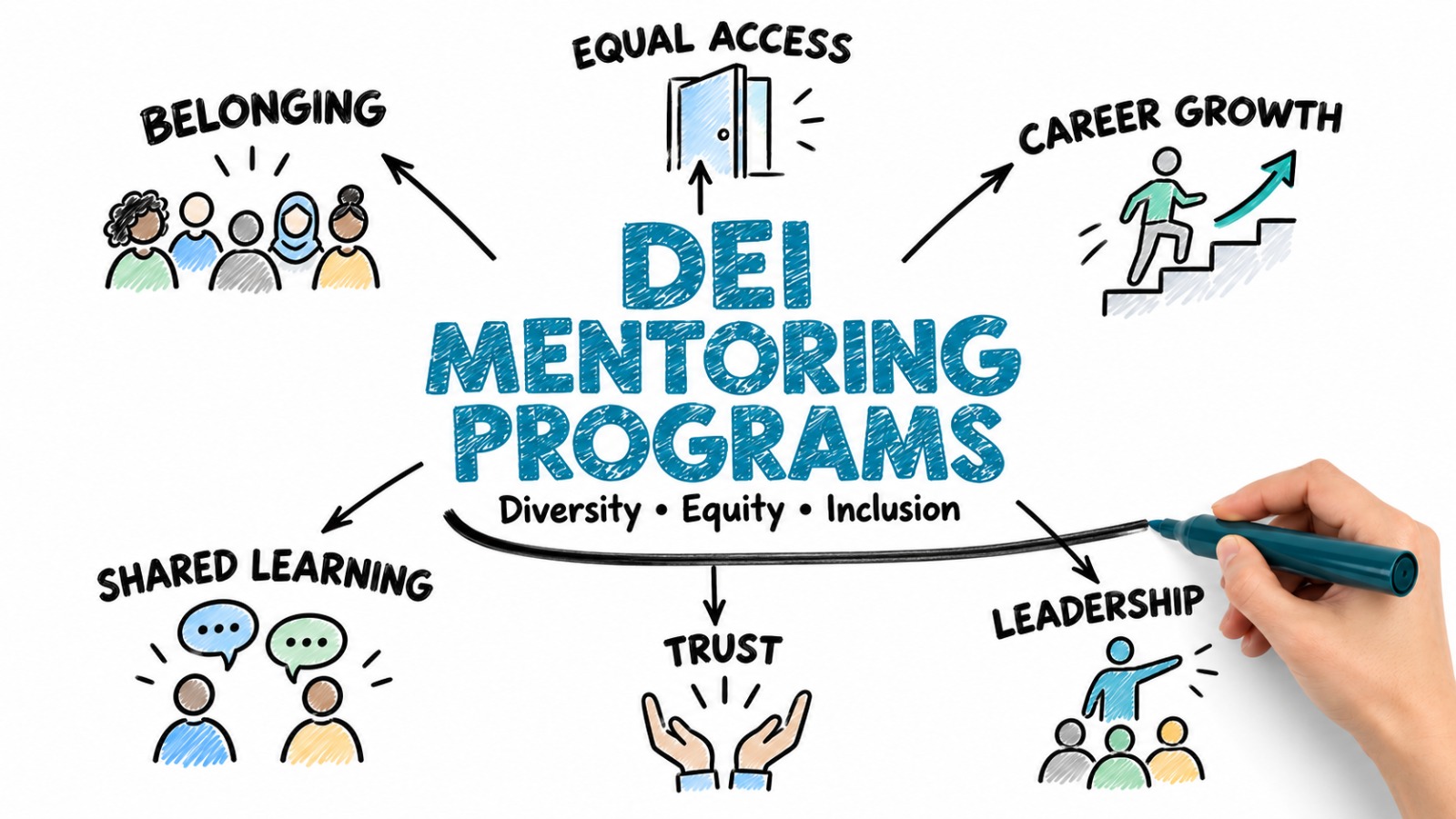
DEI mentoring is a structured program that pairs employees for guidance, support and advocacy. DEI stands for diversity, equity and inclusion. The program is designed to improve belonging, development and advancement for people who are underrepresented or under-supported at work. Unlike one-off training, it builds ongoing relationships that can support day-to-day experience and career development.
A DEI statement becomes more useful when employees can see how it affects their access to support and opportunities. Mentoring gives organizations a practical way to connect those intentions to individual development and measure the experience. It can also support employee retention more broadly, which is why many HR teams start here.
This guide explains how DEI mentoring works, the main types of programs, how to build one step by step, how to match people fairly and how to measure results. It is written for HR, L&D and DEI leaders who want a program people actually join and finish.
Why DEI needs mentoring, not just training
Good DEI intent often stalls at the policy stage. Training raises awareness, but awareness alone rarely changes who gets introduced to senior leaders, who is considered for stretch projects or who is put forward for promotion.
Those outcomes depend heavily on informal networks. People who are underrepresented often have fewer informal connections to senior leaders, and fewer people who will speak up for them when opportunities come up. Mentoring addresses that gap directly, by creating a relationship that would not have formed on its own.
A 2008 meta-analysis by Eby and colleagues found that mentoring was associated with favorable outcomes across youth, academic and workplace settings, although the effects were generally small. This supports realistic expectations: mentoring can contribute to development, but it does not guarantee a particular retention or promotion gain. Track what happens in your own program.
The difference is easy to see side by side:
| Aspect | DEI training | DEI mentoring |
|---|---|---|
| Format | One-off, periodic or sustained learning | Ongoing relationship |
| Main effect | Knowledge, awareness and skills | Guidance, connection and development |
| Who benefits | People who participate in the learning | Mentors and mentees in the relationship |
| Measurable outcomes | Learning, behavior change, attendance and completion | Relationship quality, development, retention and progression |
The two work best together. Training builds shared language, and mentoring turns it into action. If you want the wider case for mentoring first, read the power of mentorship and the impact of mentorship on individual performance and business success.
Mentoring also needs to sit alongside fair workplace processes. A mentor can help an employee prepare for a stretch assignment, but leaders still need to ensure that the assignment is advertised and awarded fairly. Repeated concerns from participants can highlight a process that needs attention, without exposing private conversations.
New to the terminology? Start with our explainer on what DEI means and why it matters at work. For a closer look at one dimension, see the impact of gender diversity at the workplace.
7 types of DEI mentoring programs
There is no single model. Most organizations start with one or two and add more as the program matures.
1. ERG mentoring
Employee resource group members are paired with mentors who understand their experience, or with leaders outside the group who want to learn from it. This is often the easiest first program, because the community already exists. Useful for belonging and engagement, with retention tracked over time. ERG programs often work well as group mentoring sessions.
2. Sponsorship and leadership pipeline
Mentors advise. Sponsors use their influence to advocate for someone's advancement: recommending them for roles, putting their name forward and opening doors. A sponsorship program pairs high-potential employees from underrepresented groups with senior leaders who commit to visible action. Best for promotion equity and a more representative leadership bench. Learn how this fits into leadership development and succession planning.
Set clear criteria for sponsorship opportunities. A mentor might help an employee prepare a proposal; a sponsor might recommend them to present it. Catalyst distinguishes mentoring from sponsorship by the sponsor’s active advocacy for advancement.
3. Reverse mentoring
Junior or underrepresented employees mentor senior leaders, sharing perspectives leaders rarely hear first-hand. It can help leaders understand employee experiences when they listen and act on what they learn. Best for executive awareness and two-way trust.
Agree on discussion boundaries before the first session. The employee should not have to speak for an entire community or share personal experiences they would prefer to keep private. The senior leader should leave with an action they can take.
4. Cross-cultural and cross-generational mentoring
Pairs people across cultures, regions, ages or functions. It creates opportunities to question assumptions and improve collaboration across teams. Best for global or multi-generational workforces. It also works as cross-functional development.
5. Women in leadership mentoring
A focused program for women moving into senior roles, often combining mentoring with sponsorship and peer circles. Best where leadership representation is the clearest gap.
6. New-hire and returnship mentoring
Supports people in their first months, and people returning after a career break. A mentor helps them rebuild confidence, networks and context faster. Best for first-year retention and faster ramp-up. See how this works for accelerated employee onboarding, and read our guide to how workplace mentoring supports people returning after a hiatus.
7. Allyship circles
Small groups of managers and colleagues who meet to learn, practice and commit to specific allyship actions. Best for turning good intentions into everyday behavior, and easy to run with group sessions.
Other audiences worth considering include neurodivergent and disabled employees, first-generation graduates and early-career hires. Each benefits from mentors who understand specific barriers.
How to build a DEI mentoring program in 7 steps
- Define the goal. Pick one or two outcomes, such as retention in a specific group, leadership pipeline or belonging scores. A clear goal decides who the program is for and what you measure.
- Choose the program type. Match the model to the goal. Belonging points to ERG or cross-cultural mentoring. Advancement points to sponsorship. Leadership awareness points to reverse mentoring.
- Set eligibility. Decide who can join. Many organizations keep programs open to everyone with voluntary participation, while using clear eligibility and selection criteria. See the legal section below.
- Recruit and prepare mentors. Give mentors a short briefing on the program goal, inclusive conversation and what is expected of them. Sponsors need a clear commitment to act, not just to advise.
- Match with intent. Use goals, skills, experience and stated preferences. More on this in the next section.
- Guide the relationship. Provide conversation prompts, goal-setting templates and scheduled check-ins, ideally through guided journey tasks and session tracking. Use early check-ins to identify scheduling problems, unclear goals or a poor match.
- Measure, learn and adjust. Review participation, satisfaction and outcomes every quarter. Share results with leadership and refine the program.
Assign a coordinator to own recruitment, matching, check-ins and concerns. Agree on protected time with managers, and make participation workable across shifts, time zones and accessibility needs. Include orientation, coordination and participant time in the budget.
Example of a six month pilot
As an illustrative plan, an employer could start with 20 pairs working toward a defined development goal, such as preparing for a first cross-functional project. Each pair meets for 45 minutes a month, with 15 minutes of preparation per person. Across 40 participants and six months, that represents 240 participant hours, before orientation and coordination.
Check match suitability after the first meeting, review usefulness at month three and discuss progress at month six. Follow retention and progression over a longer period where relevant. These are planning assumptions, not a customer result or a universal benchmark.
What to cover in the first meeting
Agree on the development goal, meeting schedule, communication preferences and confidentiality boundaries. Choose one practical action before the next meeting. Explain how either participant can contact the coordinator, raise a concern or request a rematch.
For the wider picture, see the power of efficient mentorship programs.
Matching mentors and mentees fairly
Matching is an important early decision, alongside mentor preparation and ongoing support. A few principles help:
- Make profile attributes opt-in. Participants choose what they share, such as background, identity or lived experience. Never infer it.
- Match on goals first. Start with the mentee’s goals and the mentor’s relevant skills and experience, rather than demographics alone.
- Offer choice. Let participants see a short list of suggested matches and pick, or request a change without explanation.
- Avoid assumptions. A person from an underrepresented group does not necessarily want a mentor from the same group, and may prefer someone who has navigated a similar career path.
- Check outcomes. Review whether matches are staying active across groups, and adjust if some groups drop off sooner.
Check practical fit too: availability, language, communication preferences and potential conflicts of interest. A mentor outside the direct reporting line may make candid discussion easier. Explain why profile information is collected and who can see it; do not assume that optional disclosure removes the need for appropriate data protection.
See how Mentorgain's matching handles this.
Measuring success: the DEI mentoring scorecard
Leadership will ask what the program achieved. Plan your measures before you launch, and compare participants with non-participants where you can.
| Measure | What it tells you | How to collect it |
|---|---|---|
| Participation and completion | Whether people join and stay | Program platform |
| Relationship activity | Whether pairs are meeting | Check-ins, session logs |
| Satisfaction | Whether the experience is useful | Pulse surveys |
| Belonging and engagement | Whether people feel included | Survey scores before and after |
| Retention | Whether participants stay longer | HR data, participants vs comparison group |
| Promotion and progression | Whether careers are moving | HR data, over 12 months or more |
Report results at group level, with minimum group sizes, to protect individual privacy. Mentorgain's reporting and surveys support feedback collection and program review. Agree on privacy safeguards before reporting group results.
Make the scorecard measurable
Participation rate: Enrolled employees divided by eligible employees, multiplied by 100. Report any capacity limit alongside the result.
Active-pair rate: Pairs meeting the agreed activity requirement divided by confirmed pairs, multiplied by 100. Define what counts as active before launch.
Completion rate: Participants meeting predefined completion criteria divided by enrolled participants, multiplied by 100. Explain withdrawals rather than quietly removing them.
For example, if 16 of 20 pairs meet the monthly activity requirement, the active-pair rate is 80%. That measures activity. Ask whether the conversations are useful and whether participants are making progress toward their goals as well.
Use the same belonging or engagement questions before and after the program, and report response rates. Review retention and promotion over a defined period. Where possible, compare employees in similar roles, at similar levels and with similar tenure. Volunteers may already differ in motivation or manager support, so an outcome difference does not by itself prove that mentoring caused it.
Financial ROI needs defensible cost and benefit estimates. Report participant and administration costs, describe any assumptions used to estimate savings, and keep observed outcomes separate from modeled benefits.
Common mistakes and how to avoid them
- No clear goal. Programs without a defined outcome cannot show results. Start with the goal.
- Overlooking sponsorship when advancement is the goal. Advice may need to be accompanied by access to opportunities and advocacy. Decide whether the program needs both.
- Putting the burden on underrepresented employees. Do not expect people from underrepresented groups to educate everyone else. Recognize and support mentors' time.
- Matching on assumptions. Use opt-in information and goals, not guesses.
- Letting pairs drift. Use prompts and early check-ins to help pairs address problems before they disengage.
- Tracking activity, not impact. Number of matches is not an outcome. Measure retention, belonging and progression.
- Missing practical barriers. Provide accessible materials, captions where needed, flexible meeting options and protected time. Ask participants what would make it easier to take part.
For more on why programs struggle, read why some workplace mentorship programs fail and debunking mentoring misconceptions. For building an open environment, see the power of inclusivity in the workplace.
Legal and inclusive-language considerations
Rules on programs aimed at specific groups differ by country and region. As a general approach, many organizations:
- open programs to all employees, with voluntary participation
- match on goals, skills and preferences rather than protected characteristics
- keep personal information confidential and opt-in
- use inclusive, non-stigmatizing language in program descriptions
Data handling matters too: see how Mentorgain approaches compliance and security. This is general information, not legal advice. Check your program design with your legal counsel for the places where you operate.
For US employers, the EEOC’s DEI-related discrimination guidance explicitly addresses access to mentoring and sponsorship. Open enrollment or voluntary participation alone does not establish compliance. Review selection and opportunity allocation for the jurisdictions involved.
Explain what information is collected, who can access it and when it is deleted. Agree on confidentiality limits and a route for reporting concerns outside the mentoring pair. Removing names does not necessarily make feedback anonymous, particularly in small groups.
How software helps
Many DEI programs begin on spreadsheets and email. That can work for a pilot. As participation grows, coordinating matches, follow-ups and reporting takes more administrative time.
A mentoring platform helps by handling:
- Profile-based matching using goals, experience and relevant preferences
- Conversation prompts and goal setting through journey tasks, to give pairs a shared structure
- Group and circle mentoring alongside one-to-one pairs
- AI buddy support between sessions
- Feedback surveys and program analytics, to support program review and reporting to leadership
- Integrations with the tools your teams already use
Mentorgain is built for this. See how it supports DEI mentoring programs, why teams choose mentoring software, how it helps HR leaders, and what it costs on the pricing page. When you are ready, book a demo.
FAQs
What is a DEI mentoring program?
A structured program that pairs employees for guidance and support, designed to improve belonging, development and advancement for people who are underrepresented or under-supported.
How is DEI mentoring different from regular mentoring?
Regular mentoring focuses on individual development. DEI mentoring adds an equity goal: it is designed to close gaps in access, connection and advancement, and it measures outcomes by group. Not sure how mentoring differs from coaching? See mentoring vs coaching.
Can we run DEI mentoring without excluding anyone?
Yes. Many organizations open programs to everyone, with voluntary participation and goal-based matching. Eligibility, selection and access to opportunities still need careful review. Check with legal counsel for your region.
What is the difference between mentoring and sponsorship?
Mentors advise. Sponsors use their influence to advocate for someone's advancement. Programs focused on career progression may benefit from both.
What is reverse mentoring?
A model where employees with relevant experience, often less senior colleagues, mentor senior leaders, sharing perspectives that leaders rarely hear directly.
How do you measure DEI mentoring success?
Track participation, relationship activity, satisfaction, belonging scores, retention and promotion rates, and compare participants with non-participants where possible.
How fast can we launch a DEI mentoring program?
A pilot can launch once the goal, eligibility, recruitment, mentor preparation and matching process are ready. The timeline depends on approvals and participant availability. Start with a cohort you can support, then expand after reviewing the experience.
Do we need software to run a DEI mentoring program?
Not for a small pilot. Software becomes valuable when you need fair matching, consistent check-ins and reporting across many participants. Here is why organizations choose mentoring software.
How often should mentors and mentees meet?
A monthly meeting of 45 to 60 minutes can be a useful starting point. Adjust the rhythm to the development goal, workload and time zones. Agree on a practical next step between meetings so the conversation connects to day-to-day work.
What if a mentoring match does not work?
Give both participants a private way to request a rematch through the coordinator. Check whether the issue concerns scheduling, goals or fit. Where conduct is involved, use the appropriate organizational support process as well as addressing the pairing.
DEI mentoring launch checklist
Before recruiting, confirm the program goal, eligibility criteria, coordinator and available time. Prepare the mentor briefing, matching process, first-session agenda, accessibility options and route for concerns. Define baseline measures, review dates and completion criteria before the first pair meets.
Ready to turn DEI goals into measurable action? Book a demo and use the launch checklist above to prepare your program.