.svg)
Impact of Gender Diversity at the Workplace: Beyond Equity, Embracing Evolution
.webp)
Mentoring has a warm reputation but an unusually strong evidence base. The statistics below are not motivational quotes — they are sourced findings from research conducted at Sun Microsystems, Gallup, Deloitte, Harvard Business Review, McKinsey, and others. They are the numbers HR leaders use to make the business case for structured mentoring, and the numbers that leadership teams actually engage with in budget conversations.
For the India-specific data, see our dedicated post on mentoring statistics for Indian HR leaders in 2026. For the full business case framework, see our guide on proving the mentoring ROI to your CFO.
The headline numbers
If you need five statistics to open a presentation or business case, these are the ones that hold up under scrutiny and land with leadership teams:
- Employees in structured mentoring programmes are 49% less likely to leave than non-participants
- Mentored employees are 5× more likely to be promoted; their mentors are 6× more likely to be promoted (Sun Microsystems study)
- Employees with mentors are twice as likely to be engaged at work (Gallup)
- Structured mentoring increases representation of women and minorities in management by 9–24% (Harvard Business Review)
- US businesses lose nearly $1 trillion annually to voluntary turnover — mentoring is one of the highest-ROI retention interventions available (Gallup, via Mentorloop)
Mentoring and employee retention
Retention is where the financial case for mentoring is strongest and most measurable. The cost of replacing an employee runs from 50% to 200% of their annual salary when recruitment fees, onboarding time, and lost productivity are included. For the full attrition cost calculation, see our guide on how mentoring reduces employee attrition.
- Employees in structured mentoring programmes are 49% less likely to leave than non-participants
- Cox Automotive's mentoring programme achieved 79% retention among participants over two years, against 67% company-wide (Chronus case study)
- A major US academic hospital reported 89% retention for mentoring participants versus 74% for non-participants (Chronus case study)
- Paychex's women's mentoring initiative reached 94% retention among participants — 14 points above the company average (Chronus case study)
- Millennials with mentors are twice as likely to stay five or more years — 68% versus 32% without (Deloitte Millennial Survey)
- US businesses lose nearly $1 trillion annually to voluntary turnover (Gallup, via Mentorloop)
- 90% of organisations say they are concerned about retention and recognise mentorship as a key engagement lever (LHH, via Mentorloop)
See the employee retention and engagement use case for how organisations design mentoring programmes specifically around retention outcomes.
Mentoring and career advancement
The most cited finding in mentoring research comes from a multi-year Sun Microsystems study tracking over 1,000 employees. It found mentored employees were 5× more likely to be promoted — and mentors themselves were 6× more likely to be promoted. This finding is significant not just for participants: it means mentoring is one of the few L&D investments that develops two people per hour spent.
- Mentored employees are 5× more likely to be promoted than non-mentored peers (Sun Microsystems)
- Mentors are 6× more likely to be promoted than non-mentoring peers (Sun Microsystems)
- A global tech company saw 19% higher advancement rates among mentoring participants versus non-participants (Chronus case study)
- Amazon's mentoring programme recorded an 8% higher job-change rate among participants (Chronus case study)
- 86% of participants in Paychex's women's mentoring programme achieved their stated goals (Chronus case study)
- Employees with formal mentors are 75% more likely to agree their organisation provides a clear plan for their career development (Gallup)
- 77% of companies report that mentoring programmes were instrumental in improving both retention and job performance (ASTD)
For how mentoring supports the leadership pipeline specifically, see our guide on building a leadership pipeline through mentoring and the leadership development and succession planning use case.
Mentoring and employee engagement
Only 31% of US employees are engaged at work — the lowest in a decade. Globally, engagement sits at just 21% (Gallup). Disengaged employees cost a median-size S&P 500 company between $228 million and $355 million a year in lost productivity (McKinsey). Mentoring is one of the few interventions that reliably moves this number.
- Employees with mentors are twice as likely to be engaged than those without (Gallup)
- Businesses with highly engaged employees are 18% more productive and 23% more profitable than those with disengaged employees (Gallup)
- Roughly 9 in 10 workers with a mentor report being happy in their jobs (CNBC/SurveyMonkey, via Together)
- Employees with mentors are twice as likely to have had opportunities to learn and grow in the last year (Gallup)
- 7 in 10 employees say learning improves their sense of connection to their organisation; 8 in 10 say it adds purpose to their work (LinkedIn Workplace Learning Report 2025)
- The manager alone accounts for 70% of the variance in team-level engagement (Gallup) — mentoring new managers is one of the highest-leverage development investments available. See our guide on first-time manager training for how to structure this.
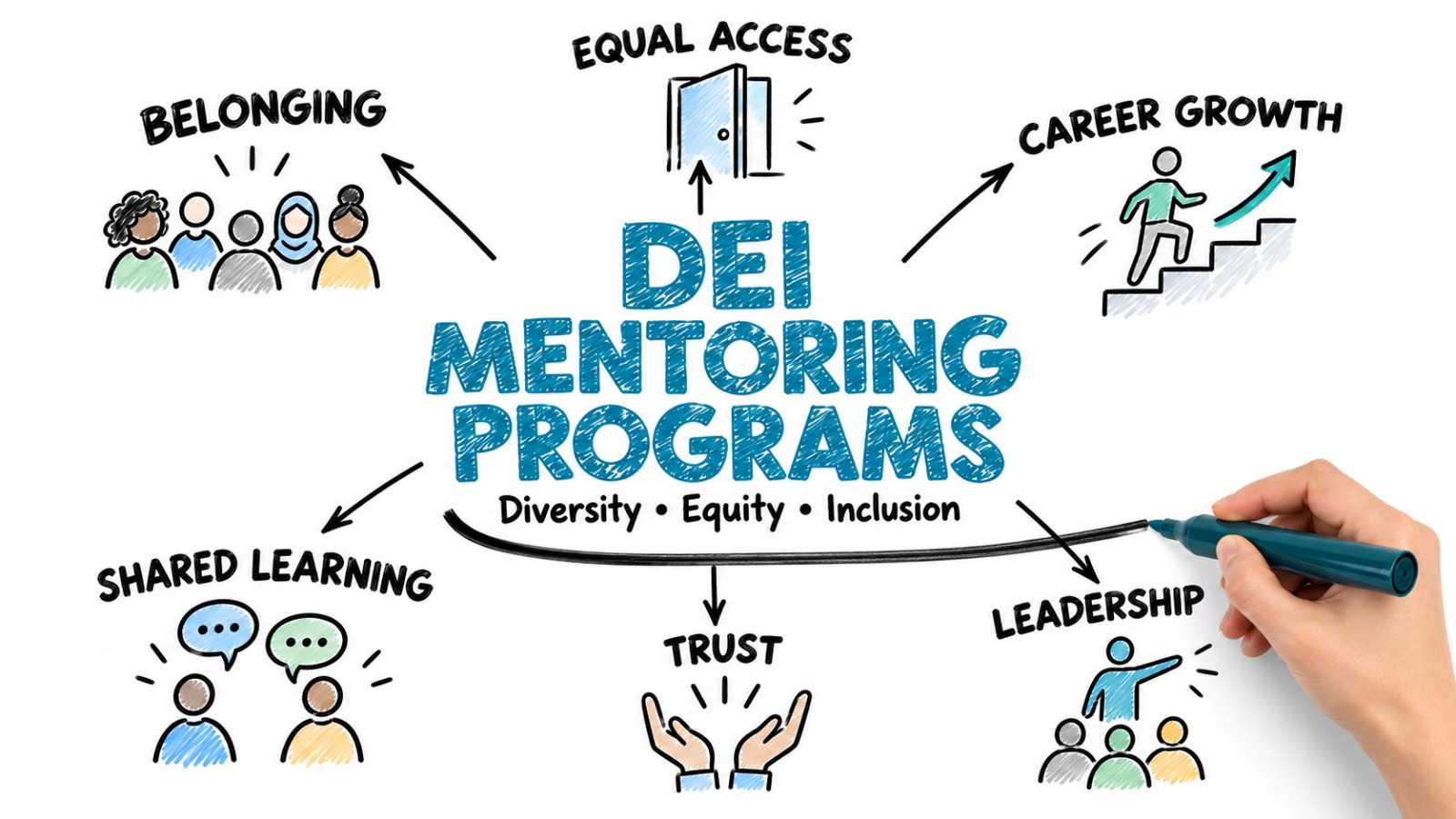
Mentoring and DEI outcomes
Informal mentoring — the kind that happens through existing networks — systematically disadvantages underrepresented groups. Formal, structured programmes with intentional matching are one of the most evidence-backed tools for closing DEI gaps. For programme design guidance, see our posts on mentoring women into leadership and the diversity, inclusion and belonging use case.
- Structured mentoring increases representation of women and minorities in management by 9–24% (Harvard Business Review)
- Promotion and retention rates for mentored minorities and women improved 15–38% versus non-mentored peers (via Mentorloop)
- Employees in formal mentoring relationships are 58% more likely to agree their workplace gives everyone equal opportunity to advance (Gallup)
- A major US academic hospital saw 88% retention among non-white mentoring participants, versus 74% for non-white employees without mentors (Chronus case study)
- Paychex's women's mentoring initiative helped increase women in leadership by 3% in two years — a shift that took the global average five years (Chronus case study)
- 86% of law firms reporting into Bloomberg Law's DEI framework use mentorship programmes to increase diversity at all levels
- Only 27% of senior-level women have had a formal mentor, compared to 38% of men (DDI, via Mentorink)
- Nearly 80% of employees want to work for a company that values DEI (CNBC/SurveyMonkey)
- 95% of mentees see value in having a mentor from a different background (via Mentorloop)
Mentoring adoption — the gap between supply and demand
The most revealing statistic in the whole mentoring dataset is the gap between how many organisations claim to have mentoring programmes and how many employees actually have a mentor.
- As many as 97.5% of Fortune 500 companies have mentoring programmes in place (The Times, via Together)
- Only 37% of employees currently have a mentor (CNBC/SurveyMonkey, via Together)
- Mentoring sits at #4 among L&D priorities in 2026 — up from #6 in 2021, the largest rank jump of any strategy (Donald H Taylor Global Sentiment Survey, via Mentorloop)
- 54% of women report being asked to mentor only a few times or never in their careers (DDI, via Mentorink)
This gap between programme existence and actual access is exactly what structured matching addresses. For how algorithmic matching closes the equity gap, see our guide on automated mentor matching vs manual spreadsheets.
Mentoring ROI — the business case in numbers
| Outcome | With mentoring | Without mentoring | Source |
|---|---|---|---|
| Retention (enterprise programmes) | 72% | 49% | Programme research |
| Retention — Cox Automotive (2-year) | 79% | 67% | Chronus case study |
| Retention — US academic hospital | 89% | 74% | Chronus case study |
| Millennials staying 5+ years | 68% | 32% | Deloitte |
| Likelihood of promotion (mentees) | 5× higher | Baseline | Sun Microsystems |
| Likelihood of promotion (mentors) | 6× higher | Baseline | Sun Microsystems |
| Engaged at work | 2× as likely | Baseline | Gallup |
| Happy in their job | ~9 in 10 | Lower | CNBC/SurveyMonkey |
| Management representation (women/minorities) | +9–24% | Baseline | Harvard Business Review |
For how to translate these numbers into a financial business case for your specific organisation, see our guide on proving the mentoring business case to your CFO and our post on mentoring programme benefits.
Why the numbers are consistent — and what they mean for programme design
The striking thing about mentoring research is how consistent the findings are across different methodologies, industries, and geographies. Whether the study is looking at a hospital, a tech company, a financial services firm, or an NGO, the pattern holds: structured mentoring produces better retention, faster advancement, higher engagement, and stronger DEI outcomes than informal mentoring or no mentoring at all.
The consistent variable across the programmes that produce these results is structure. Open-ended, informal relationships produce inconsistent outcomes. Programmes with defined goals, intentional matching, session frameworks, and measurement produce the numbers above. For the full structural framework, see our guide on mentoring programme structure and our post on what structured mentoring is and why it works.
The implication for programme design is straightforward: the investment in structure — intentional matching, session guidance, midpoint check-ins, formal close — is what converts good intentions into the statistics above. Without it, programmes produce participation data. With it, they produce the retention, advancement, and engagement numbers that make the business case self-evident.
For why programmes that have all the right intentions still fall short, see our post on why mentoring relationships fail. For the platform that handles the structural layer, see Mentorgain's mentoring software.
Frequently asked questions
What percentage of employees have a mentor?
Only about 37% of employees currently have a mentor, despite 97.5% of Fortune 500 companies claiming to have mentoring programmes (CNBC/SurveyMonkey and The Times, via Together). The gap between programme existence and actual participant access is the central challenge in workplace mentoring — and the primary problem that structured matching solves. See how Mentorgain's matching engine addresses this.
How much does mentoring improve employee retention?
Employees in structured mentoring programmes are 49% less likely to leave than non-participants. Real programme data shows retention rates of 79–94% for mentored employees versus 49–74% for non-mentored peers depending on the organisation. Replacing an employee costs 50–200% of annual salary — retained employees produce a significant financial return on the programme investment. See the employee retention use case for programme design guidance.
Are mentors promoted more often than non-mentors?
Yes. The Sun Microsystems study found mentors were 6× more likely to be promoted — a higher multiple than mentees (5×). This is one of the most counterintuitive findings in mentoring research: the act of mentoring develops leadership capability, communication, and organisational visibility for the mentor as much as it develops the mentee. See our breakdown of mentor and mentee roles for what each party brings and gains.
How does mentoring affect diversity and inclusion?
Structured mentoring is one of the most evidence-backed DEI interventions available. Harvard Business Review research found it increases representation of women and minorities in management by 9–24% — a stronger effect than most other diversity initiatives. The key is intentional, algorithmic matching: informal mentoring tends to reproduce existing networks and advantage the already-advantaged. See our post on mentoring women into leadership and the DEI use case.
What is the ROI of a mentoring programme?
ROI is primarily driven by reduced attrition. If a structured programme retains three to five employees who would otherwise have left, the saving in replacement costs typically exceeds the annual platform investment many times over. Organisations with mentoring cultures also report 18% higher productivity and 23% higher profitability than peers (Gallup). For the full calculation, see our guide on proving the mentoring business case to your CFO.
Does mentoring work for all types of organisations?
Yes. The research base covers organisations ranging from hospitals and law firms to tech companies, NGOs, and manufacturing plants. The consistent finding is that structure — not sector, size, or geography — is what determines whether a programme produces results. For sector-specific applications see our posts on mentoring in non-profits, mentoring programmes in Singapore, and mentoring statistics for India.
How do you use mentoring statistics to make a business case?
Lead with the attrition cost calculation specific to your organisation, then anchor it to the retention statistics above. Show what a 15–20% improvement in retention among programme participants saves in replacement costs, then compare that saving to the platform investment. The numbers almost always show a strong return within the first cohort. For the full framework, see our guide on getting leadership buy-in for a mentoring platform.
.webp)



.webp)