Employee retention and engagement
Mentoring gives employees a sense of belonging, support and clarity - all of which reduce attrition and strengthen commitment.
.svg)
Workplace mentoring
Workplace mentoring connects mentors and mentees across your organization to accelerate learning, build leadership capability, transfer knowledge, plan for succession and strengthen inclusion.
India-founded · Global delivery · INR and USD pricing




%201.svg)

%201.svg)
%201%20(2).svg)
The answer
Workplace mentoring is a structured way for people in an organization to learn from one another. A mentor shares experience, context and guidance while a mentee brings goals, questions and fresh perspectives. The relationship helps individuals build capability and helps organizations strengthen leadership, culture and connection.
With Mentorgain, mentoring becomes an intentional and measurable program that can support onboarding, first-time managers, leadership development, knowledge transfer, succession planning, employee retention, inclusion and AI literacy. Guided journeys and clear reporting help program teams turn useful conversations into visible progress without intruding on the relationship.
Business and people impact
Well-designed mentoring strengthens the employee experience while helping organizations retain knowledge, develop leaders and build capability at scale.
Mentoring gives employees a sense of belonging, support and clarity - all of which reduce attrition and strengthen commitment.
Mentors help employees learn faster, avoid repeated mistakes and access institutional knowledge that is not written down anywhere.
Structured mentoring helps identify emerging leaders early and prepare them for future roles through guidance, exposure and real-world problem-solving.
Mentoring creates psychological safety, supports underrepresented groups and gives more people access to guidance and growth.
Employees who feel supported show higher morale, lower burnout and stronger motivation.
Across your people strategy
Mentoring supports people at important career moments and helps organizations build a more capable, connected workforce.
Help new hires build context, confidence and useful internal connections.
Give new managers regular access to experienced leaders and practical guidance.
Prepare current and emerging leaders for broader responsibility.
Transfer critical knowledge and build future-ready talent pipelines.
Keep practical expertise moving between teams and generations.
Help people build confidence using AI responsibly in day-to-day work.
The quality of the match
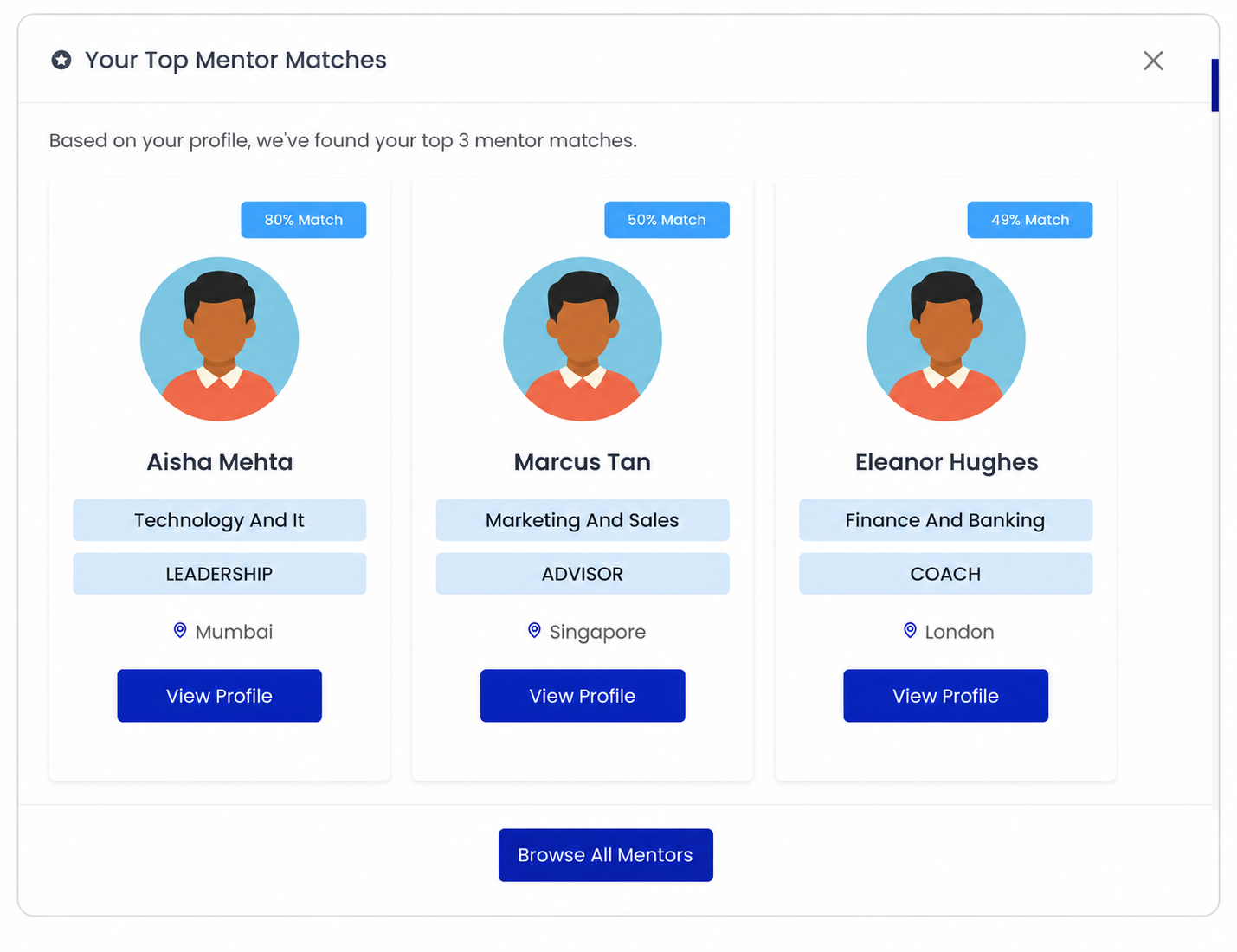
A relevant match makes mentoring more useful from the first conversation by connecting goals and challenges with the right experience.
Mentors with experience in a specific role, domain or challenge can offer insights people can apply immediately - not generic advice.
A good match helps the mentor understand where a mentee wants to go and the steps needed to get there.
When employees feel supported by someone who understands them, they show stronger commitment, lower burnout and better performance.
The right mentor helps people think clearly, make better choices and approach challenges with a sense of direction.
A well-matched relationship creates trust - an essential ingredient for honest conversations, feedback and real growth.
Relevant guidance means fewer mistakes, quicker upskilling and smoother transitions into new roles or responsibilities.
A practical program model
Define the audience, program goal and measures of progress.
Use skills, goals, experience and preferences to support relevant matches.
Give mentors and mentees sessions, goals, resources and useful next steps.
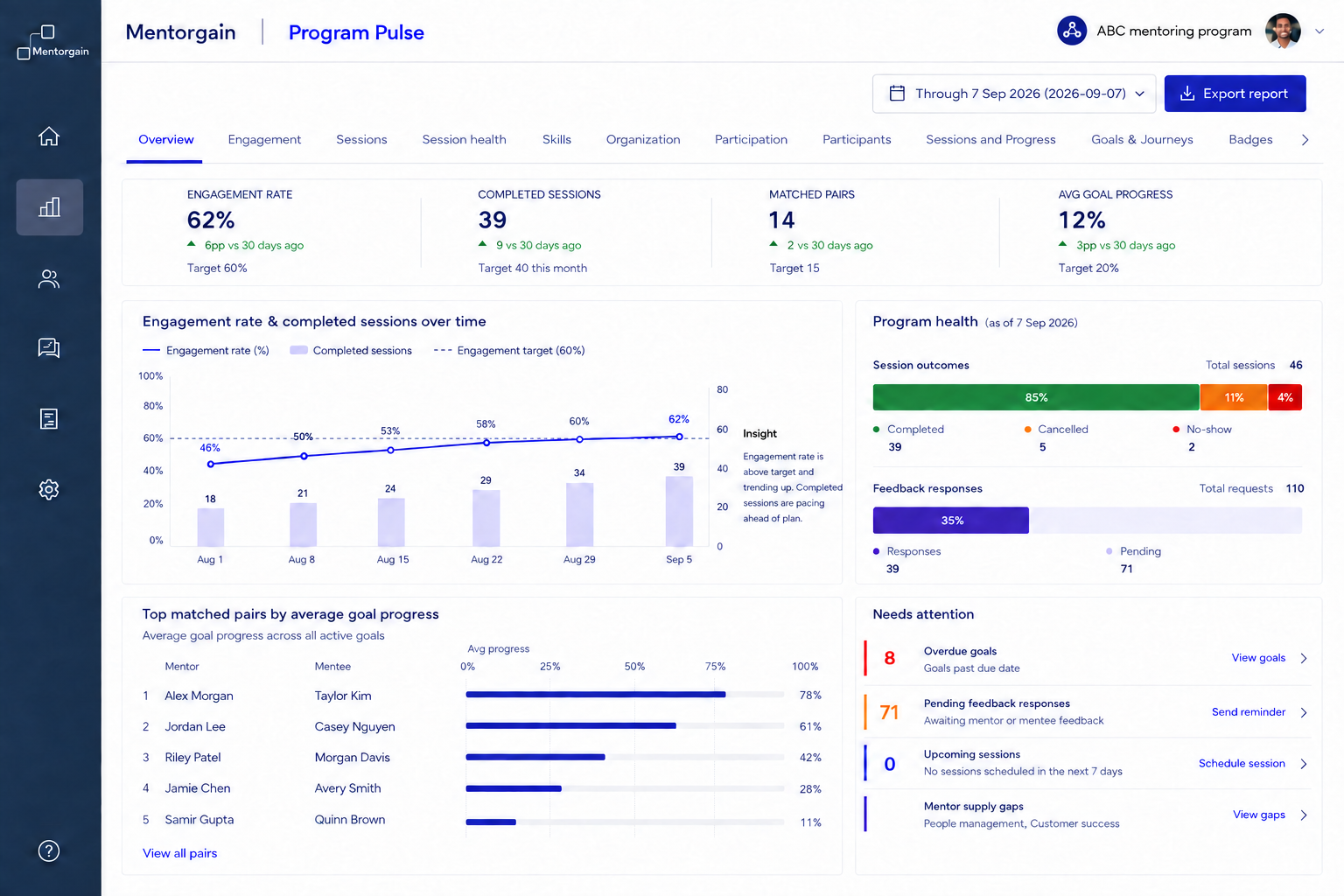
Review participation, feedback and outcomes while the program is running.
Make the relationship work
Effective mentoring programs combine structure with flexibility. These practical activities help mentoring relationships start well and keep moving.
From conversation to progress
Mentorgain gives program teams the structure and visibility they need while keeping the participant experience simple and personal.
Out of all the vendors we have worked with, your team truly stands out. In the past, even getting a single feature changed used to be a struggle, so we are really impressed with how closely you listened to our feedback and implemented the improvements.
Workplace mentoring FAQ
Start with the questions organizations ask when they plan a workplace mentoring program.
Workplace mentoring is a structured relationship in which a mentor shares experience, context and guidance with a mentee. Organizations use it to support development goals while strengthening connection, capability and knowledge transfer.
A strong program starts with a clear purpose and audience, matches mentors and mentees using relevant criteria, gives pairs a useful journey, and reviews participation and outcomes over time.
Mentorgain can support onboarding, first-time manager development, leadership development, succession planning, knowledge transfer, inclusion initiatives, employee retention and AI literacy programs.
Programs can match participants using goals, skills, experience, preferences and organization-specific criteria. Program teams can review suggested matches before launch.
Yes. Mentorgain supports virtual and in-person mentoring programs, multiple cohorts and organization-level configuration for different teams and locations.
contact us
Book an exploratory call with our team and see how Mentorgain can work for your organization.
.webp)