20 Workplace Mentoring Activities for Every Stage of the Relationship
November 27, 2026
Gauri Gokhale
Workplace mentoring activities help mentors and mentees turn conversation into practice. Start with activities that build trust and clarify goals, move into observation and skill development, then use reflection and a deliberate close to make the learning last. Choose one activity that fits the mentee’s current need, agree on a next step, and review what happened at the following meeting.
The first mentoring conversation can feel easy. Introductions fill the time, both people share a little background, and there is plenty to discuss. By the fourth meeting, the question can become more awkward: what should we actually do today?
A useful activity gives the meeting a purpose without turning it into a training session. It might involve rehearsing a difficult conversation, reviewing a piece of work, or working out who could help the mentee understand another part of the business.
This guide brings together 20 mentoring activities across five stages of the relationship. Each includes practical instructions, a suggested time allowance, and something concrete to take away. The timings and sequence are suggestions, not a validated curriculum. Adapt them to the people and the work.
What are workplace mentoring activities?
Workplace mentoring activities are purposeful exercises that help a mentor and mentee explore a development goal, practise a skill, share experience, or reflect on progress. They can happen during a meeting or between sessions. Unlike a social icebreaker, a mentoring activity connects the relationship to something the learner wants to handle differently at work.
The CIPD’s coaching and mentoring factsheet, dated 11 August 2025, describes mentoring as a development relationship involving shared knowledge and skills such as listening and questioning. It also emphasises learning for both participants. That is a useful starting point: the mentor contributes experience, while the mentee brings a real question and room to try something new.
Choose an activity for the stage you are in
| Relationship stage | Activities | Purpose |
|---|---|---|
| Build trust | 1 to 4 | Learn how to work together |
| Set direction | 5 to 8 | Choose a goal and a first step |
| Practise and apply | 9 to 12 | Try a skill in real work |
| Broaden perspective | 13 to 16 | Explore people and opportunities |
| Review and close | 17 to 20 | Recognise progress and plan what follows |
These stages are flexible. An established pair may need to revisit expectations after a change of role. Someone approaching a promotion may move straight into rehearsal. Let the development need guide the choice.
Stage 1: Build trust and agree how to work together
1. Share three career turning points
Time: 20 minutes.
Each person chooses three moments that changed how they work: a decision, a setback, or an unexpected opportunity. Take turns explaining what happened and what you learned. The listener asks one follow-up question about each story. Keep it work-related, and let either person pass on anything they would rather keep private.
Leave with: One shared interest and one difference in experience worth exploring later.
2. Create a working agreement
Time: 25 minutes.
Agree how often you will meet, who will arrange meetings, how you will reschedule, and what contact between sessions feels reasonable. Discuss confidentiality and its limits under your organisation’s policies. Ask what each person expects from the relationship and what is outside its scope. A mentor should not promise a promotion or absolute confidentiality.
Leave with: A short agreement both people can revisit. Use the mentoring session questions and agendas to shape your first meeting.
3. Compare your feedback preferences
Time: 15 minutes.
Each person completes two sentences: “Feedback helps me when…” and “I find feedback difficult when…”. Discuss whether written comments, immediate discussion, or time to reflect works best. Then practise with a small, low-stakes example, such as feedback on a meeting agenda. Check whether the delivery felt useful rather than assuming you understood.
Leave with: Two or three preferences that make honest feedback easier to exchange.
4. Map the support you already have
Time: 20 minutes.
The mentee lists people they turn to for technical advice, career perspective, organisational context, and encouragement. Look for gaps without naming or judging colleagues unnecessarily. Ask where this mentor can add something and where another person would be better placed. This helps avoid expecting one relationship to meet every development need.
Leave with: A clear role for the mentor and one other source of support to approach.
Stage 2: Turn broad ambitions into a workable goal
5. Describe a better working week
Time: 20 minutes.
Ask the mentee to describe a normal week three months from now if mentoring has been useful. What would they do more confidently? Which task would take less effort? What would a colleague notice? Bring the discussion down to observable behaviour. “Lead the weekly project update without relying on my manager” is easier to work with than “be more confident”.
Leave with: One practical description of the change the mentee wants.
6. Review strengths through real examples
Time: 30 minutes.
Choose two pieces of recent work, such as a presentation and a project handover. Discuss what went well, what required help, and what the mentee would change. The mentor should ask about the context before offering an opinion. Use approved or anonymised material, and avoid turning a development conversation into an unofficial performance rating.
Leave with: One strength to use more deliberately and one skill to practise.
7. Build a goal ladder
Time: 25 minutes.
Put the larger ambition at the top of a page, then work backwards to a milestone and a small action. For a mentee who wants to lead projects, the milestone might be running one planning meeting. The first action could be drafting its agenda. Add a date and agree what evidence would show progress. See these career development goals for mentees for starting points.
Leave with: A goal, a milestone, and an action small enough to begin this week.
8. Run an obstacle rehearsal
Time: 20 minutes.
Ask: “Imagine we meet next month and nothing has changed. What got in the way?” Explore workload, access, confidence, unclear expectations, or competing priorities. Choose the most likely obstacle and write an if-then response. For example: “If the project meeting is cancelled, I will ask to lead the next team update instead.”
Leave with: A realistic backup plan for the first action.
Stage 3: Practise skills and use them at work
9. Rehearse a difficult conversation
Time: 30 minutes.
The mentee chooses a real conversation they are preparing for, such as clarifying a deadline or disagreeing with a stakeholder. Explain the context, then role-play the opening five minutes. Pause to discuss wording, tone, and the other person’s likely concerns. Switch roles if useful and try again. Keep formal grievances or misconduct concerns within the appropriate organisational process.
Leave with: An opening statement, a useful question, and a next step for the actual conversation.
10. Observe a meeting and debrief
Time: 45 to 75 minutes.
With the relevant permissions, the mentee observes a meeting led by the mentor or another colleague. Choose one thing to watch, such as how disagreement is handled. Afterwards, compare what the mentee noticed with what the meeting leader intended. If attendance is inappropriate, use an approved case or reconstruct a non-sensitive example together.
Leave with: One technique to test in the mentee’s next meeting.
11. Try a teach-back
Time: 25 minutes.
The mentee explains a process or concept as if the mentor were new to it. The mentor asks questions where the explanation becomes unclear, then the mentee tries again using a simpler example. This works for technical knowledge, onboarding, and communicating across functions. If the mentor is learning a tool from the mentee, reverse the roles.
Leave with: A clearer explanation and a short list of knowledge gaps to check.
12. Run a small work experiment
Time: 30 minutes to plan, plus practice between meetings.
Choose one behaviour to change for a week or two. A mentee might send a short decision summary after meetings or ask one clarifying question before accepting a brief. Record what they currently do, what they will try, and what feedback they can gather. At the next session, review what happened and whether the change is worth keeping.
Leave with: A tested habit, with examples of what improved and what still needs adjustment.
Stage 4: Broaden perspective and explore opportunities
13. Draw a stakeholder map
Time: 30 minutes.
Choose a project or career goal and map the people affected by it. Discuss what each person needs, what the mentee understands about their work, and where assumptions need checking. The aim is to understand responsibilities and perspectives, not to rank colleagues by political usefulness. Pick one relationship that would benefit from a better conversation.
Leave with: One purposeful conversation to arrange and two questions to ask.
14. Explore another team’s work
Time: 30 minutes, plus an optional introduction.
Identify a team whose work affects the mentee’s role. Write down what you think that team does and where you are uncertain. Ask a colleague, with their agreement, for a short conversation about priorities, constraints, and handovers. Afterwards, discuss which assumptions changed and what the mentee can do differently.
Leave with: A more accurate view of the other team and one improvement to collaboration.
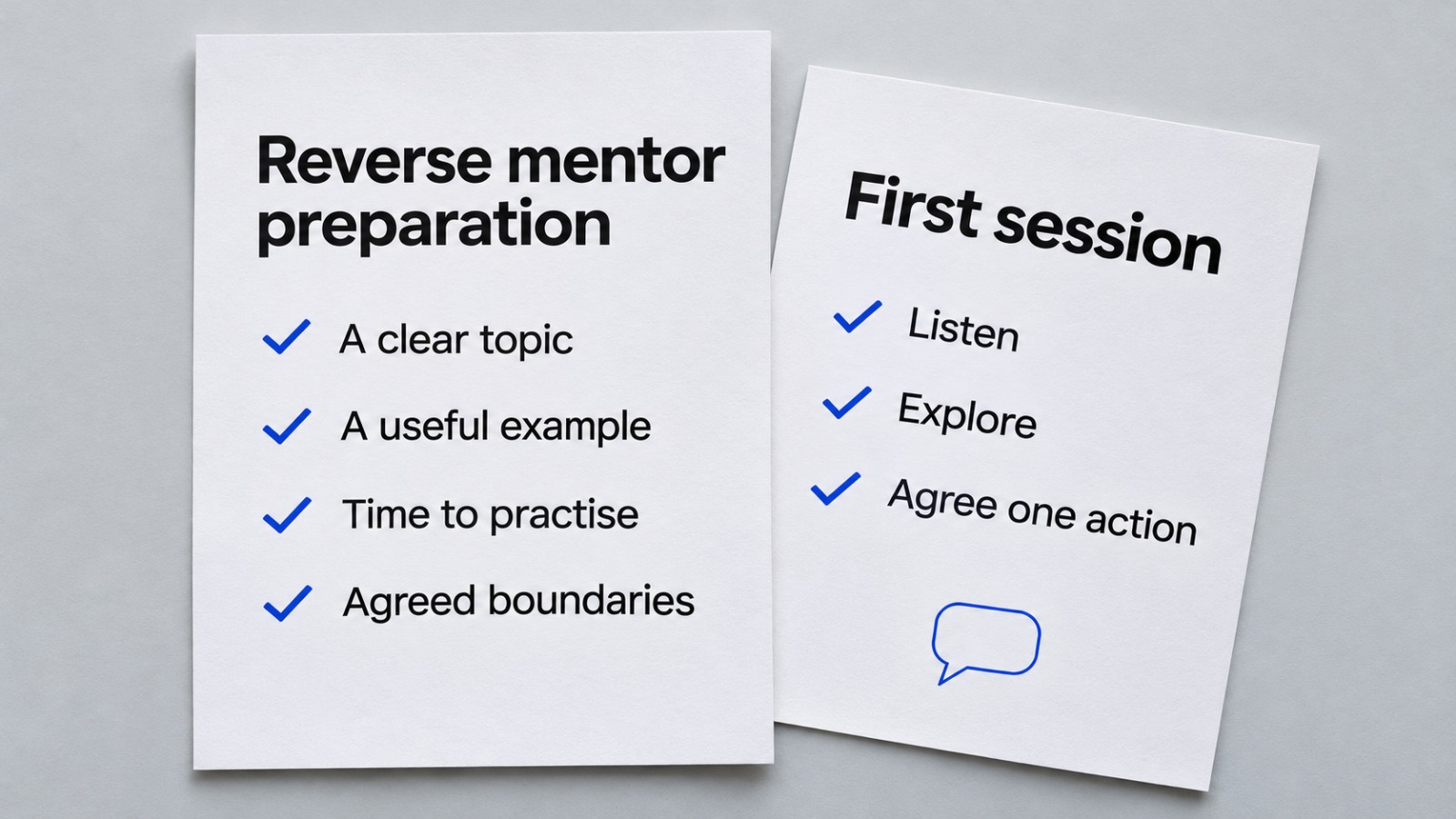
15. Hold a reverse mentoring exchange
Time: 30 minutes.
Each person brings something the other knows less about. A mentee might demonstrate a current workflow, while the mentor explains how a business decision is evaluated. Agree the learning question first and use a real example. Do not assume expertise from age or seniority: ask what each person actually knows and wants to learn.
Leave with: One insight each person will apply, making the exchange useful in both directions.
16. Compare two possible next moves
Time: 35 minutes.
Choose two realistic options, such as deepening a specialist skill or taking on a coordination role. Compare the daily work, capabilities needed, trade-offs, and information still missing. The mentor can share experience without deciding for the mentee. Identify a small way to test an option before making a major commitment.
Leave with: A decision to make, missing information to gather, and one low-risk test.
Stage 5: Review progress and close deliberately
17. Revisit the starting point
Time: 30 minutes.
Bring back the original goal and compare it with recent work. Ask what the mentee can now do with less help and what evidence supports that view. A better presentation, a clearer decision, or feedback from a colleague is more useful than a confidence score alone. Discuss other influences, including training and changes in responsibility.
Leave with: A brief record of progress without attributing every improvement to mentoring.
18. Build a learning portfolio
Time: 30 minutes.
Select three examples that show development, with permission to retain or share them. For each, note the challenge, what the mentee tried, what happened, and what they learned. Remove confidential details. The portfolio can be a private reflection document; it does not need to become a presentation for the programme owner.
Leave with: Three concrete examples the mentee can use in future development conversations.
19. Exchange feedback on the relationship
Time: 25 minutes.
Discuss what each person found useful, what they would change, and whether the level of structure felt right. Ask about preparation, listening, follow-through, and the relevance of advice. Make room for feedback that is less flattering. Agree what, if anything, can be shared with the programme team, using its stated privacy arrangements.
Leave with: One lesson for each participant and appropriate feedback for improving the programme.
20. Create a plan for the next 90 days
Time: 30 minutes.
Choose one goal the mentee will continue independently, one habit to maintain, and one person or resource to turn to if they get stuck. Decide whether the formal relationship is ending or changing, and agree any future contact explicitly. Thank each other for specific contributions rather than letting the final meeting disappear from the calendar.
Leave with: A manageable next-step plan and a clear ending or agreed new arrangement.
How to choose mentorship activities for adults
Useful mentorship activities for adults respect experience, choice, and limited time. Start with a current work problem. Explain why the activity might help, then let the mentee help shape it. A forced personal disclosure or a game with no obvious relevance can make a professional relationship feel uncomfortable.
Before choosing an activity, ask three questions: Does this connect to the goal? Are both people comfortable taking part? Can we identify something to try or understand afterwards? If the answer to any is no, choose a different activity.
Make participation accessible. Send prompts in advance when helpful, offer written reflection as an alternative to speaking on the spot, and adapt exercises for different communication needs. For virtual pairs, a shared document can replace a whiteboard. For group mentoring, use individual preparation and equal speaking time, while allowing participants to pass.
Fit an activity into a normal mentoring session
For a 45-minute meeting, a practical starting point is five minutes to check in, five to review the previous action, 25 for one activity, and ten to reflect and choose what happens next. Longer observation activities can take place between meetings, with the next session reserved for the debrief.
Do not try to complete all 20 activities. A pair working on stakeholder communication might use a working agreement, a goal ladder, conversation rehearsal, and a progress review. Another pair may spend several meetings on one work experiment. Repetition can be more useful than novelty.
If the mentee arrives with an urgent development question, make room for it. The activity supports the conversation; it should not become another obligation to tick off.
How programme owners can support useful activities
Give participants a short menu of activities, with guidance on when each is useful. Ask pairs to record an agreed action and review date where appropriate. Keep private reflections separate from programme reporting, and explain who can see any information collected.
Mentorgain’s mentoring journeys and tasks can provide structure around goals, actions, and progress. Its session tracking supports visibility of mentoring sessions, while reporting and surveys help programme teams collect feedback and review participation. These tools can support the rhythm around the relationship; the pair still chooses what is useful to discuss.
When reviewing effectiveness, look beyond completed activities. Ask whether participants tried something at work, received useful feedback, or made progress towards their goal. A completed exercise is evidence of participation, not proof of improved retention or performance.
To give your mentoring pairs a more consistent path from introductions to practical development, explore Mentorgain’s mentoring software. Start with a clear goal and a small selection of activities, then adjust based on what participants find useful.
Frequently asked questions
What are examples of mentoring activities?
Examples include a career timeline, a working agreement, goal setting, conversation role-play, meeting observation, teach-back, stakeholder mapping, and a progress review. Choose an activity that helps the mentee address a current work or career goal.
What should you do in the first mentoring meeting?
Use the first meeting to understand each other’s experience, discuss the mentee’s priorities, and agree how the relationship will work. A career turning-point discussion and a short working agreement give the conversation structure without requiring an elaborate exercise.
Which workplace mentoring activities work remotely?
Goal ladders, conversation rehearsals, teach-backs, stakeholder maps, and learning reviews can all work over video or in a shared document. Use approved tools, offer preparation time, and avoid recording personal conversations unless everyone has agreed and organisational policy permits it.
How often should you use a mentoring activity?
Use an activity when it helps move the goal forward. One focused activity can anchor a session, with practice between meetings. You do not need a new exercise every time, especially when an ongoing experiment or work challenge needs further discussion.
How do you know whether a mentoring activity worked?
Look for a useful result: a clearer goal, a practised skill, a decision, or an action the mentee has applied at work. Review evidence at a later meeting. Satisfaction and completion can help identify what participants value, but they do not establish business impact on their own.
Sources
CIPD, Coaching and mentoring. Factsheet dated 11 August 2025. Accessed 27 November 2026. Used for the definition and general principles of mentoring. The activity instructions, suggested timings, and five-stage organisation in this article are practical editorial recommendations.
Mentorgain product pages and linked resources were checked on 27 November 2026. Product references describe publicly documented capabilities; no outcome guarantees are implied.