.svg)
.jpeg)
Every HR leader has sat through a budget conversation where L&D spend is the first line to get cut. But mentoring is different — and the data makes that case compellingly.
Organisations with structured mentoring programs see 50% higher employee retention, 70% increases in productivity, and 18% better profitability than their peers. Seventy-nine percent of millennials say mentorship is critical to their career success.
This guide lays out the full business case at the individual, team, and organisational level — with the data you need to take to your leadership team. If you have already decided to build a program and need the structural framework, see our companion post on mentoring program structure. For the data on why mentoring consistently outperforms training alone, see our post comparing mentoring vs training.
The three levels of benefit
The benefits of a structured mentoring program operate simultaneously across three levels. Most HR leaders make the mistake of pitching only the individual-level benefit. The most compelling business case operates at all three levels at once.
Individual level: what mentees and mentors gain
The mentee benefit is well understood: faster career development, clearer direction, access to experience they would otherwise have to wait years to accumulate. What is less discussed is what mentors gain — and the research is consistent that mentoring is nearly as valuable for the mentor as for the mentee.
Mentors report improved leadership capabilities, a stronger sense of purpose, and greater visibility within their organisation. Senior employees who mentor tend to stay longer and report higher engagement scores. They are also better managers — the act of articulating how they approach problems actively sharpens those skills.
The mentee benefits in detail:
- Accelerated career progression: Mentored employees are promoted five times more often than their non-mentored peers (widely cited in mentoring research, originating from a Sun Microsystems internal study)
- Stronger skill development: Mentoring delivers contextualised learning — applied to the mentee's actual role and challenges — which produces faster and more durable skill development than classroom training. For the full comparison, see our post on mentoring vs training.
- Higher job satisfaction: Mentored employees report significantly higher satisfaction, largely because they feel seen, supported, and on a path that makes sense to them
- Better manager relationships: When employees have a mentor — particularly outside their direct reporting line — they tend to have healthier relationships with their managers, because the mentoring relationship handles the development conversations that often create tension in management relationships
Read our full breakdown of mentor and mentee roles to understand what each party is bringing to the relationship — and what good looks like on both sides.
Team level: what managers and departments gain
The team-level benefits are often invisible until they are quantified. Consider what structured mentoring produces in terms of knowledge transfer alone. Every organisation has knowledge that exists only in the heads of its most experienced employees. When those people leave, that knowledge walks out the door. Mentoring is one of the few mechanisms that actively transfers tacit knowledge — the kind that cannot be written into a process document — from experienced employees to the people who will need it next.
For teams specifically, mentoring produces:
- Faster onboarding: New employees with a structured mentor reach full productivity 30–40% faster than those relying on manager guidance alone. See the accelerated onboarding use case for how organisations design these programs.
- Reduced management overhead: When employees have a mentoring relationship handling development conversations, managers spend less time in reactive mode
- Cross-functional collaboration: Mentoring pairs often cross departmental lines, building relationships and understanding between teams that would otherwise have minimal contact
- Knowledge transfer before exits: When a senior employee is planning to transition out, a structured mentoring relationship can be the vehicle for capturing and transferring their most valuable institutional knowledge — see our post on building a leadership pipeline through mentoring
Organisational level: what the business gains
There are four organisational outcomes that a structured mentoring program directly affects.
Retention — the most measurable benefit
Employee attrition is expensive in a way that most organisations systematically undercount. The most commonly cited cost of replacing an employee is 50–200% of their annual salary, accounting for recruitment, onboarding time, lost productivity, and the institutional knowledge that leaves with the departing employee. For a 500-person organisation with 15% annual attrition, that is 75 replacements per year — at a conservative average replacement cost of ₹5 lakhs per employee, a ₹3.75 crore annual bill.
Structured mentoring programs reduce attrition because they address the most common reason high-performers leave: the perception that they are not growing fast enough. When an employee has a mentor actively supporting their development, they can see a path forward. The reason to leave shrinks. The employee retention and engagement use case shows how organisations design programs specifically around retention outcomes.
Leadership pipeline — the strategic benefit
The most expensive leadership problem organisations face is not finding external talent. It is failing to develop the internal talent they already have.
Structured mentoring programs are the most cost-effective mechanism for building leadership pipelines. They identify high-potential employees early, expose them to senior leaders, give them structured development experiences, and make them visible. Read our detailed guide on building a leadership pipeline through mentoring, or explore the leadership development and succession planning use case.
Employee engagement — the productivity benefit
Employee engagement drives productivity. Organisations with highly engaged workforces outperform their peers by 23% in profitability (Gallup). Mentoring is one of the highest-impact drivers of engagement because it directly addresses what engagement surveys consistently identify as the top factors: feeling that the organisation is invested in your development, having a sense of growth, and feeling connected to colleagues who care about your success.
For the statistics behind this, our post on mentoring statistics for HR leaders consolidates the most compelling research.
DEI outcomes — the equity benefit
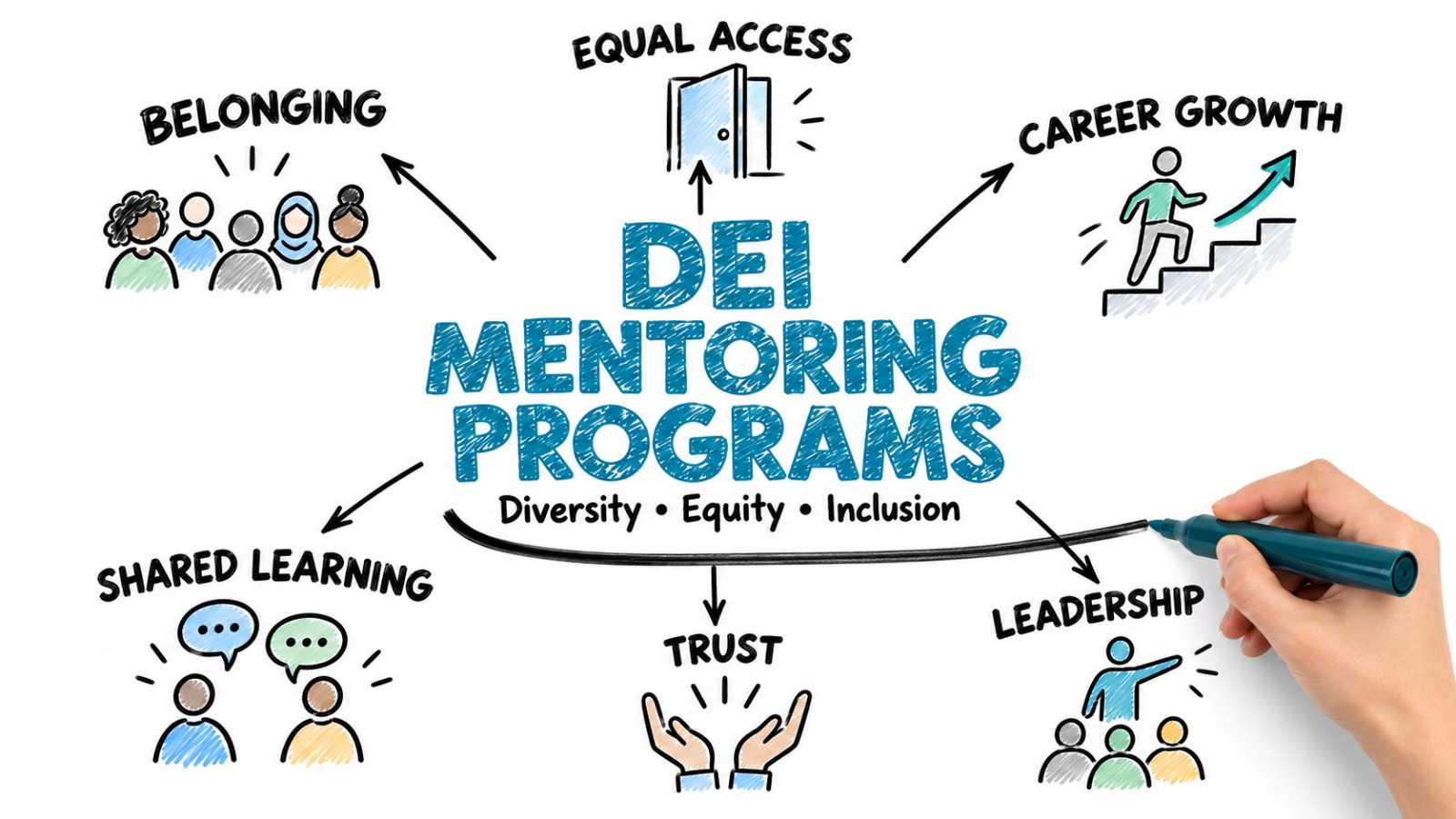
Informal mentoring — the kind that happens organically through professional networks — systematically disadvantages employees from underrepresented groups. Formal, structured programs with algorithmic matching are one of the most effective tools for creating equitable access to development. Organisations running structured mentoring programs alongside DEI initiatives see faster progress on representation targets.
See our dedicated posts on mentoring women into leadership and the diversity, inclusion and belonging use case for how to design programs with equity outcomes explicitly built in.
The cost-of-attrition calculation: how to make the business case in numbers
When presenting the business case for a mentoring program to leadership, the most persuasive argument is a simple attrition cost calculation. Here is how to run it.
For a full guide on building and presenting this case internally, see how to get leadership buy-in for a mentoring platform. Our HR leaders resource page also has templates and frameworks for this conversation.
Why the benefits of informal mentoring are not enough
Many organisations believe they already have mentoring — because senior employees informally advise junior ones, or because managers have development conversations with their direct reports. These things have value. They are not a substitute for a structured program.
Informal mentoring reaches only the employees who already have the confidence and network to seek it out. It is invisible to HR, so it cannot be measured or improved. And because it has no structure, the quality is wildly variable. Our post on why mentoring relationships fail explores exactly how unstructured programs fall apart — and what structure prevents.
For a direct comparison of what dedicated mentoring software provides that informal approaches cannot, see our guide on why organisations choose a mentoring software platform over DIY approaches.
How Mentorgain delivers these outcomes
Mentorgain is a structured mentorship platform designed to produce the organisational outcomes described in this guide. Our AI-powered matching creates quality pairs based on goals, skills, and experience. Our structured journeys ensure every mentoring relationship has a framework that produces outcomes. Our analytics dashboard gives HR teams the data to prove program impact to leadership.
If you are building the business case for a mentoring program and would like help running the numbers for your specific organisation, book a conversation with our team. Or explore Mentorgain's pricing to understand what the investment looks like relative to the returns calculated above.
Frequently asked questions
Higher employee retention (up to 50% higher for organisations with structured programs), faster leadership development, improved engagement and productivity, stronger knowledge transfer, better DEI outcomes, and measurable ROI through reduced attrition costs. For the supporting data, see our post on mentoring statistics for HR leaders.
ROI is primarily driven by reduced attrition costs. Replacing an employee costs 50–200% of their annual salary. If a structured mentoring program retains even three to five employees who would otherwise have left, the savings typically exceed the program investment many times over. Companies with mentoring cultures also report 18% better profitability than peers. See how to get leadership buy-in for how to frame this in an internal presentation.
Mentoring addresses the growth visibility gap — the most common reason high-performers leave is not compensation, but feeling they are not progressing fast enough. A structured mentoring relationship gives employees visibility into their own development path, which directly reduces the motivation to leave.
Yes, significantly. Mentors report improved leadership capabilities, greater sense of purpose, higher engagement, and stronger organisational visibility. See our guide on the mentor vs mentee relationship for what both parties gain.
Informal mentoring has significant limitations: it is not equitably distributed, invisible to HR, cannot be measured, and variable in quality. For why structure matters, see why mentoring relationships fail and our overview of why dedicated mentoring software matters.
Mentorgain's team can help you run the attrition cost calculation for your specific headcount and help you design a program structure that delivers measurable retention and development outcomes.




.webp)