.svg)
How to Build a Leadership Pipeline Through Mentoring
September 8, 2026
Gauri Gokhale
A large manufacturing company lost its CHRO last year. Sudden resignation. Two weeks' notice.
Fifteen years of institutional knowledge walked out with her. The search for a replacement took four months. During those four months, the annual appraisal cycle was delayed, a flagship leadership development programme stalled, and two senior HR managers who had been quietly waiting for clarity about their own growth started looking elsewhere.
The organisation had a succession plan. It was a well-formatted document. It named three people as potential successors for senior roles. What it did not have was any actual preparation of those people for the roles they were named against — no structured development, no ongoing mentoring, no conversation about readiness. The names were on a slide. The slide had not been updated in two years.
This is not an unusual story. According to a 2025 SHRM India report, nearly 67% of mid-to-large Indian enterprises admit they do not have a documented succession plan beyond the top two leadership levels. And among those that do have a plan, most of it lives in a deck — not in the day-to-day development of their people.
The problem is not that Indian organisations do not value leadership continuity. They do. The problem is that they confuse succession planning with succession documentation. A list of names is not a pipeline. A pipeline is something you build over time, through deliberate, structured development — and mentoring is the most effective tool for doing exactly that.
Why Most Succession Plans Do Not Work
The DDI Global Leadership Forecast 2025, one of the largest leadership studies ever conducted, found that 75% of organisations prioritise internal promotion, but only 20% of HR leaders have successors who are actually ready for critical roles.
The gap between intent and readiness is not a mystery. It has a cause.
Most succession plans are built backwards. Organisations identify a vacancy risk, name candidates, then leave those candidates to develop themselves. The assumption is that talented people in challenging roles will grow into what the organisation needs. Sometimes they do. More often, they develop the capabilities required for their current role — not the role they are being groomed for.
Structured mentoring closes this gap because it develops people forward, not just upward. A high-potential mid-level manager who is matched with a senior leader and given a structured development journey over six to twelve months does not just perform better in her current role. She builds visibility, gains strategic perspective, understands how decisions get made at the top, and develops the exact capabilities the organisation needs her to have when the time comes.
What Makes India's Succession Challenge Different
Leadership succession in Indian organisations carries context that Western frameworks do not fully account for.
Family-owned businesses make up a significant proportion of India's mid-to-large enterprise landscape. Deloitte India's 2025 research found that 57% of next-generation leaders in Indian family enterprises join the business before the age of 27. The succession question in these organisations is not just about competency — it is about the transition from founder instinct to professional management, and about building trust between family leadership and institutional talent.
Beyond family businesses, Indian enterprises face a structural problem: the leadership bench is thin at the layer just below the CXO. Middle managers in India are often excellent executors and technically strong, but have had limited exposure to strategic thinking, cross-functional decision-making, or the kind of leadership complexity that senior roles demand. This is not a talent problem. It is a development problem. And it is one that a well-designed mentoring programme can directly address.
There is also the AI fluency challenge. Korn Ferry's 2026 research found that only 11% of leaders say their executives are well-prepared to lead through the AI transition. For Indian organisations — many of whom are mid-transformation in their technology journeys — this creates an urgent, specific gap in the leadership pipeline: the next generation of senior leaders needs to be AI-literate in a way the current generation often is not.
The Role Mentoring Plays in Building a Real Pipeline
Succession planning that works looks like this: you identify the roles that are critical to organisational continuity, you identify the people who have the potential to grow into those roles, and then you deliberately create the conditions for that growth to happen — before you ever need it.
Mentoring is not the only development tool for this, but it is one of the most important. Here is why.
It creates the relationships that succession requires
Leadership transitions are not just capability transitions — they are relationship transitions. When a senior leader leaves, their successor does not just need the technical skills for the role. They need the trust of the teams around them, the credibility with senior stakeholders, and the organisational knowledge that usually comes only from proximity to power over time. Mentoring builds this. A structured mentoring relationship between a senior leader and a high-potential successor creates the visibility, the sponsorship, and the internal credibility that no training programme can replicate.
It develops the capabilities that are hardest to train
You can teach someone to read a P&L. You cannot easily teach someone to hold their nerve when the organisation is under pressure, or to make a decision with incomplete information, or to have a difficult conversation with someone twice their age in a hierarchical culture. These are the capabilities that distinguish senior leaders, and they are developed through experience and reflection — which is exactly what a good mentoring relationship provides.
It surfaces readiness faster
One of the recurring failures of succession plans is that organisations discover their named successors are not ready only when the vacancy appears. A structured mentoring programme that is integrated with clear development milestones and regular feedback loops allows HR leaders to see — in real time — who is progressing and who needs a different kind of support. Session tracking and reporting give HR leaders real-time visibility into how relationships are progressing — so you are never surprised when a review meeting comes around. This transforms succession planning from a once-a-year review exercise into a living, visible process.
How to Build a Mentoring-Led Leadership Pipeline: A Step-by-Step Framework
Step 1: Map the roles that matter most
Start with a clear-eyed assessment of which roles in your organisation carry the highest succession risk. These are typically roles where the incumbent is within five years of retirement or likely transition, there is no obvious internal successor, or the knowledge required is highly specific and difficult to hire externally. For most Indian enterprises, this exercise surfaces three to five critical roles at the first pass. That is enough to start.
Step 2: Identify high-potential candidates thoughtfully
The instinct is often to look for people who are already performing well in their current roles. That is necessary but not sufficient. The candidates you want for a leadership pipeline are people who demonstrate the capacity to think and operate at a higher level of complexity. A few useful signals: who seeks out feedback and does something with it, who builds trust across functions, who asks questions that go beyond their immediate brief, and who shows genuine curiosity about the business as a whole.
Step 3: Design structured mentoring journeys
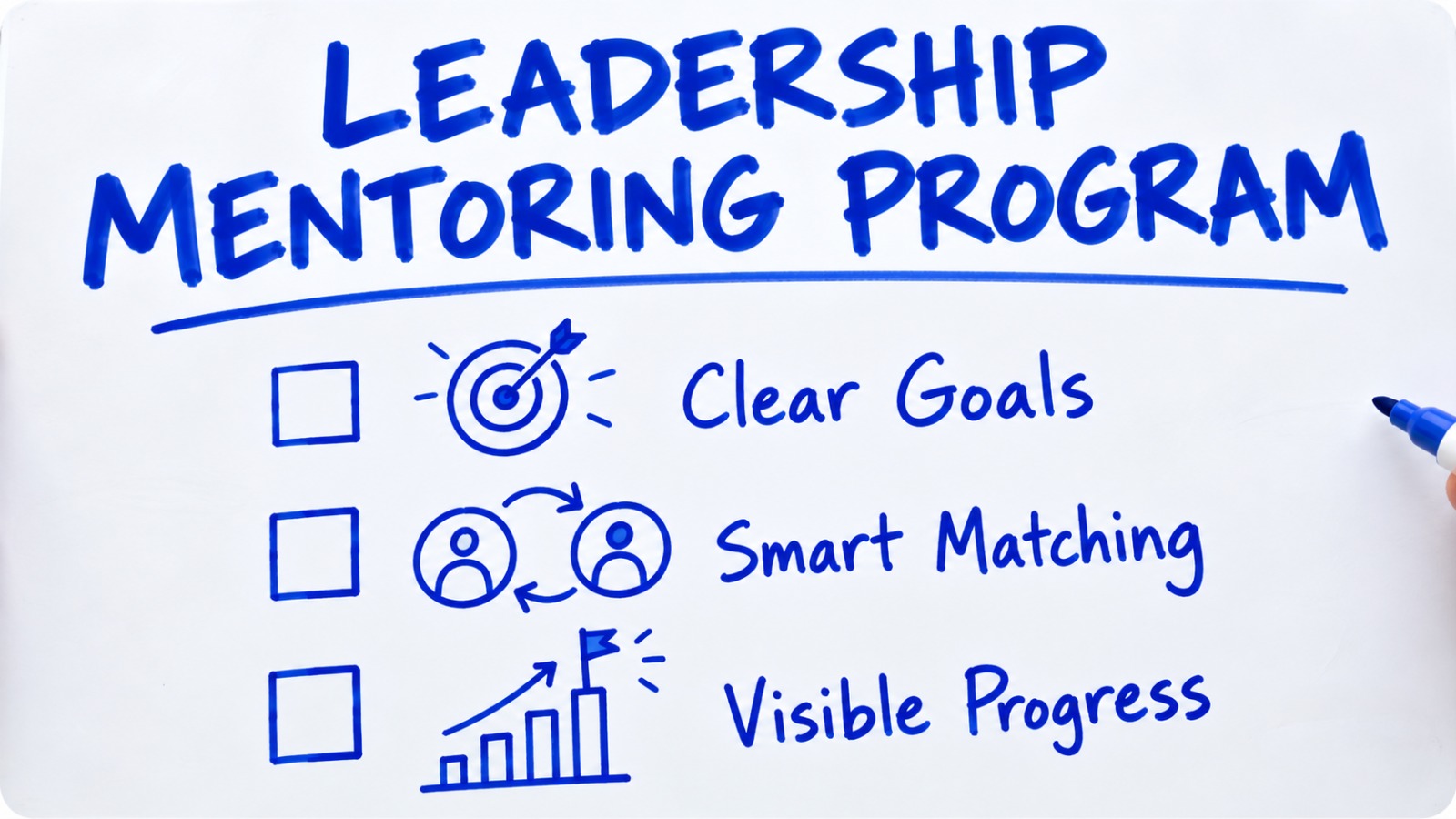
Pairing a high-potential employee with a senior leader and calling it succession planning is not enough. The mentoring relationship needs a structure that supports the specific development the candidate needs for the target role. This means defined goals at the start, a structured journey with specific themes or focus areas at each stage, regular check-ins that are documented and reviewed, and a mechanism for the programme manager to see how relationships are progressing across the cohort. Mentorgain's journey and tasks feature allows programme managers to design structured development paths with defined milestones for each stage.
Step 4: Build visibility and sponsorship into the programme
One of the biggest reasons high-potential employees stall is not lack of capability — it is lack of visibility. In hierarchical organisations, talented people often do not get seen by the people who make promotion decisions because they are not in the same room. A succession mentoring programme should explicitly address this. Mentors should be sponsors as well as coaches — actively advocating for their mentees in talent review meetings and opening doors to relationships and conversations that would otherwise be inaccessible.
Step 5: Measure progress, not just participation
The question is not whether your mentoring programme is running. The question is whether your succession candidates are getting demonstrably more ready for the roles you need them to be ready for. Build a measurement framework that tracks the development milestones each candidate is hitting, feedback from mentors on readiness progress, performance in stretch assignments, and the proportion of critical roles that have a succession candidate at each stage of readiness. Mentorgain's analytics dashboard tracks participation rates, session frequency, goal completion, and engagement health across the entire programme cohort.
The 12-Month Mentoring Journey for a Succession Candidate
A structured annual journey might follow four distinct phases:
- Months 1 to 3 — Understanding the business: The mentee builds a broader picture of how the organisation works across functions, with the mentor providing access, context, and introductions.
- Months 4 to 6 — Developing strategic thinking: Sessions focus on how senior decisions get made, how to frame complexity, and how to communicate upward effectively.
- Months 7 to 9 — Navigating leadership challenges: The mentee works through real challenges they are facing with the mentor's guidance, building the judgment and confidence that senior roles require.
- Months 10 to 12 — Stretch and visibility: The mentee takes on a stretch assignment or leads a cross-functional initiative, with the mentor acting as sponsor and debrief partner.
Common Mistakes Indian CHROs Make with Succession Mentoring
Naming too many people
If everyone is high potential, no one is. A succession mentoring programme that tries to include every manager above a certain grade quickly becomes a general L&D programme. The development is diluted, the mentor relationships are stretched thin, and the succession benefit disappears. Start with your five to ten most critical roles and your five to ten most genuinely high-potential candidates.
Leaving mentors without structure
Senior leaders are busy. When you ask them to mentor a high-potential employee without giving them a clear framework for what the relationship should look like, what they should be working on, and how progress will be tracked, the relationship often falls into pleasantries and general career advice. That is not succession development. The structure has to come from the programme, not from the individual relationship.
Treating it as an annual exercise
Succession planning that happens once a year — in a talent review meeting where names are written in boxes — is a compliance exercise. Succession development that happens continuously, through structured mentoring relationships that are actively managed and reviewed, is the real thing. The mindset shift from event to process is the most important one.
Ignoring the emotional dimension
Succession is politically charged in most organisations. Being named as a potential successor creates both pressure and expectation. Not being named creates resentment. The programme design needs to account for this. How you communicate about the programme, who is included and on what basis, and how you support people who are developing but not yet ready — all of this matters enormously for the psychological safety that good development requires.
What Good Looks Like: A Practical Benchmark
An organisation running a well-designed succession mentoring programme should, within twelve to eighteen months, be able to say:
For each of our five critical roles, we have at least two internal candidates who are actively developing toward readiness. Each of those candidates has a structured mentoring relationship with a senior leader who is actively invested in their growth. We review readiness quarterly, not annually. And when a senior leader left last quarter, we filled the role internally within six weeks, with a successor who had been in a structured development journey for the previous year.
That is not aspirational. That is achievable. The organisations that get there are the ones that treat succession development as an ongoing programme — not a planning document.
How Mentorgain Supports Succession Planning
Mentorgain's structured mentoring platform is built for exactly this kind of programme. The matching engine pairs high-potential employees with the right senior mentors based on development goals, not just seniority. The journey and tasks feature allows programme managers to design structured development paths with defined milestones for each stage. Session tracking and reporting give HR leaders real-time visibility into how relationships are progressing — so you are never surprised when a review meeting comes around.
For Indian organisations that need to move from succession documentation to succession development, Mentorgain provides the infrastructure to do it at scale — without the administrative overhead that makes these programmes collapse under their own weight.
Frequently Asked Questions
What is the difference between succession planning and succession development?
Succession planning is the process of identifying which roles need successors and naming the candidates for those roles. Succession development is the active work of preparing those candidates for readiness — through structured learning, mentoring, stretch assignments, and ongoing feedback. Most organisations do the first. The ones that build resilient leadership pipelines do both.
How long should a succession mentoring programme run?
A meaningful succession mentoring relationship needs a minimum of six months and ideally runs for twelve. This is enough time to move through distinct development phases — from building strategic context to developing leadership judgment to demonstrating capability in stretch situations. Shorter programmes tend to stay at the level of general career advice.
How many succession candidates should a programme include?
A focused succession programme typically covers five to fifteen high-potential candidates — corresponding to the most critical roles in the organisation. The goal is depth of development, not breadth of participation. If your programme includes more than twenty people in its first year, it is more likely an L&D initiative than a succession programme.
What makes a good succession mentor?
The most effective succession mentors are senior enough to provide genuine strategic perspective, credible enough within the organisation to act as sponsors, and willing to invest real time and thought in the relationship. They do not need to be the direct line manager — in fact, cross-functional mentoring relationships often produce stronger development because they expose the mentee to different parts of the business.
How do you measure the success of a succession mentoring programme?
The primary measure is readiness: what percentage of your critical roles have at least one succession candidate who is assessed as ready now or ready within twelve months? Secondary measures include mentor and mentee engagement, development milestone completion rates, and — over time — internal promotion rates for programme alumni. See how Mentorgain tracks these metrics across your entire programme.
Can a small or mid-sized Indian company run a succession mentoring programme?
Yes, and in some ways it is easier at smaller scale. A company with 500 to 1,000 employees typically has five to ten roles that are genuinely critical to succession, and a pool of ten to twenty high-potential employees. Running a structured mentoring programme for that group is entirely manageable — especially with a platform that automates matching, journey management, and tracking.
Building a leadership pipeline is not a one-time project. It is one of the most important ongoing responsibilities an HR leader has — and structured mentoring is the most reliable way to do it. The organisations that get this right are the ones that are still winning five years from now, not scrambling to fill vacancies when they can least afford to.
If you want to see how Mentorgain can support your succession mentoring programme, book a free exploratory call with our team.




.webp)