.svg)
Mentoring Statistics 2026: The Data Behind Why Mentorship Works
October 2, 2026
Gauri Gokhale
Every HR leader has felt this moment: you propose a mentoring program, and someone in the room asks, "But does it actually work?"
Fair question. Mentoring has a warm, fuzzy reputation, and warm and fuzzy doesn't survive a budget meeting. What does survive a budget meeting is data — and the data on mentoring is unusually strong. Strong enough that PwC's survey of 4,702 CEOs found 45% don't believe their organisations will remain viable in ten years on their current trajectory — and building an agile, continuously learning workforce is one of the few credible answers to that. Mentoring sits at the heart of it.
So we've pulled together the most important mentoring statistics for 2026 — on retention, promotions, engagement, diversity, and ROI — with a linked source next to every number, so the next time someone asks "does it actually work?", you have an answer that holds up. For the full business case and ROI framing, see our guide on proving the mentoring business case to your CFO.
Mentoring statistics at a glance
If you only have thirty seconds, these are the numbers that matter:
- Roughly 98% of Fortune 500 companies have mentoring programs — yet only about 37% of employees currently have a mentor (Together, citing The Times and CNBC/SurveyMonkey)
- Mentored employees are 5x more likely to be promoted; their mentors are 6x more likely (Sun Microsystems study)
- Employees with mentors are twice as likely to be engaged at work (Gallup)
- Mentees retain at around 72%, versus 49% for employees with no mentoring involvement (enterprise program data)
- Millennials with mentors are twice as likely to stay 5+ years — 68% vs 32% (Deloitte Millennial Survey)
- Structured mentoring lifts representation of women and people of colour in management by 9 to 24% (Harvard Business Review)
- US businesses lose nearly $1 trillion a year to voluntary turnover (Gallup, via Mentorloop) — most of it preventable
Mentored vs non-mentored: side by side
Sometimes the clearest way to see the effect is to put the numbers next to each other:
| Outcome | With mentoring | Without mentoring | Source |
|---|---|---|---|
| Retention (enterprise programs) | 72% | 49% | Program research |
| Retention, 2 years (Cox Automotive) | 79% | 67% | Chronus case study |
| Retention (US academic hospital) | 89% | 74% | Chronus case study |
| Millennials staying 5+ years | 68% | 32% | Deloitte |
| Likelihood of promotion (mentees) | 5x higher | baseline | Sun Microsystems study |
| Likelihood of promotion (mentors) | 6x higher | baseline | Sun Microsystems study |
| Engaged at work | 2x as likely | baseline | Gallup |
| Believe career development is supported | 75% more likely | baseline | Gallup |
| Happy in their jobs | ~9 in 10 | lower | CNBC/SurveyMonkey, via Together |
Every row tells the same story from a different angle: the presence of a mentor consistently moves the outcome, across companies, industries, and generations.
1. Adoption: everyone says mentoring matters — few actually have a mentor
The gap between belief and access is the single most revealing statistic in this entire piece.
The Times has reported that as many as 97.5% of Fortune 500 companies have mentoring programs in place. And yet, only around 37% of employees actually have a mentor right now (CNBC/SurveyMonkey, via Together). Think about that mismatch. Nearly every large company claims a program exists — but two out of three employees still aren't in one. The programs exist on paper; access hasn't caught up.
In L&D priority rankings, mentoring now sits at #4 among strategies teams are prioritising — up from #6 in 2021, the largest rank jump of any strategy (Donald H Taylor Global Sentiment Survey, via Mentorloop). The intent is clearly there. The execution gap is where most organisations lose the plot — usually because the program runs on spreadsheets and goodwill rather than structure. We've written about why that happens, and how to avoid it, in our guide to launching a mentorship program.
2. Retention: the strongest business case in HR
If you remember one section of this article, make it this one, because employee turnover is brutally expensive — Gallup estimates US businesses lose nearly $1 trillion annually to voluntary turnover (via Mentorloop).
Here's what mentoring does to that number:
- Enterprise program data shows mentees retained at 72%, versus 49% for non-participants — a 23-point gap
- Cox Automotive's mentoring program achieved 79% retention among participants over two years, against 67% company-wide (Chronus case study)
- A major US academic hospital reported 89% retention for mentoring participants versus 74% for non-participants (Chronus case study)
- When Paychex ran a mentoring initiative for high-potential women, participant retention hit 94% — 14 points above the company average (Chronus case study)
- Millennials with mentors are twice as likely to stay five or more years — 68% versus 32% without (Deloitte Millennial Survey)
- In high-turnover organisations, highly engaged workforces see 21% less turnover; in low-turnover organisations, the gap widens to 51% (Gallup)
- 90% of organisations say they're concerned about retention and recognise mentorship as a key engagement lever (LHH, via Mentorloop)
The mechanism isn't mysterious. People rarely leave purely over salary — they leave over stalled growth, weak belonging, and the sense that nobody in the organisation is invested in their future. A mentor addresses all three at once. We've broken down exactly how this works in our piece on how mentoring reduces attrition and our full guide on employee retention mentoring strategies.
3. Career growth: mentoring moves people up — including the mentors
One of the most cited findings in mentoring research comes from a multi-year study at Sun Microsystems, which tracked over a thousand employees:
- Mentees were 5x more likely to be promoted than employees without mentors (Sun Microsystems study)
- Mentors themselves were 6x more likely to be promoted (Sun Microsystems study)
That second number surprises people every time. Mentoring isn't charity flowing one way — the act of mentoring builds leadership judgment, communication, and visibility for the mentor too. It's one of the few L&D interventions that develops two people per hour invested. For how the two roles differ and complement each other, see our explainer on mentor vs mentee roles.
The pattern repeats in real program data:
- A global tech company saw 19% higher advancement rates among mentoring participants versus non-participants (Chronus case study)
- Amazon's Mentoring Program (AMP) recorded an 8% higher job-change rate among participants (Chronus case study)
- 86% of participants in Paychex's women's mentoring program achieved their stated goals (Chronus case study)
- 77% of companies report that mentoring programs were instrumental in improving both retention and job performance (ASTD)
- Employees with formal mentors are 75% more likely to strongly agree their organisation provides a clear plan for their career development (Gallup)
- 94% of millennials with mentors say they receive good advice from them (Deloitte)
Mentoring is also one of the fastest ways to develop first-time managers — the career stage where people most often sink or swim. See the leadership development and succession planning use case for how organisations design programmes around this outcome.
4. Engagement and productivity: the quiet multiplier
The engagement picture is grim: only 31% of US employees are engaged at work — the lowest in a decade — and globally, engagement sits at just 21% (Gallup, via Mentorloop). Disengagement isn't just a morale problem; it costs a median-size S&P 500 company between $228 and $355 million a year in lost productivity (McKinsey).
Mentoring is one of the few interventions that reliably moves this needle:
- Employees with mentors are twice as likely to be engaged than those without (Gallup)
- Businesses with highly engaged employees achieve 18% more productivity and are 23% more profitable than those with disengaged employees (Gallup)
- Employees who are happy at work are 12% more productive than their less-happy counterparts (University of Warwick)
- Roughly 9 in 10 workers with a mentor report being happy in their jobs (CNBC/SurveyMonkey, via Together)
- Employees with mentors are twice as likely to strongly agree they've had opportunities to learn and grow at work in the last year (Gallup)
- 7 in 10 employees say learning improves their sense of connection to their company, and 8 in 10 say it adds purpose to their work (LinkedIn Workplace Learning Report 2024)
- 44% of workers aged 18 to 34 are considering changing jobs due to insufficient learning and development opportunities (Cypher Learning)
There's also a hidden productivity drain that mentoring directly addresses: knowledge silos. 1 in 3 employees spends over 6 hours a week duplicating or reinventing work that someone else in the organisation has already figured out — simply because that knowledge was never shared (Panopto Workplace Knowledge and Productivity Report). Mentoring is, at its core, a knowledge-transfer mechanism. Every session moves hard-won judgment from one head into another, instead of leaving it locked away until it walks out the door.
5. DEI: where mentoring outperforms almost everything else
Diversity initiatives have a mixed track record — but mentoring is the consistent outlier:
- Research published in Harvard Business Review found mentoring boosted minority representation at management level by 9 to 24%, a far stronger effect than most other diversity initiatives
- Promotion and retention rates for mentored minorities and women improved 15 to 38% versus non-mentored employees (via Mentorloop)
- Employees in formal mentoring relationships are 58% more likely to strongly agree their workplace gives everyone equal opportunity to advance to senior management (Gallup)
- A major academic hospital saw 88% retention among non-white mentoring participants, versus 74% for non-white employees without mentors (Chronus case study)
- Paychex's women's mentoring initiative helped increase women in leadership roles by 3% in two years — a shift that took the global average five years (Chronus case study)
- 86% of law firms reporting into Bloomberg Law's DEI framework use mentorship programs to increase diversity at all levels (Bloomberg Law)
- About 6 in 10 CHROs report using mentoring programs to address DEI (Gallup)
- Nearly 80% of employees want to work for a company that values DEI (CNBC/SurveyMonkey)
- 95% of mentees see value in having a mentor from a different background (via Mentorloop)
The access gap remains real, though: only around 27% of senior-level women have had a formal mentor, compared to 38% of men, and 54% of women report being asked to mentor only a few times or never in their careers (DDI, via Mentorink). This is precisely why informal, who-you-know mentoring isn't enough — it reproduces existing networks. See our posts on mentoring women into leadership and the diversity, inclusion and belonging use case for how organisations design programmes with equity built in.
6. The structure gap: why most programs underdeliver
Here's the uncomfortable statistic hiding underneath all the good news: most mentoring programs never produce these results, because most mentoring programs are informal, unmanaged, and unmeasured.
The pattern is predictable. Enthusiastic launch, spreadsheet matching, a flurry of first meetings — then reschedules pile up, conversations drift into casual check-ins, and six months later nobody can say whether the program worked. What works for 10 pairs breaks at 100. For the full breakdown of how this happens, see our post on why mentoring relationships fail.
The data on structure is telling:
| Aspect | Informal / spreadsheet-run | Structured (mentoring platform) |
|---|---|---|
| Matching | Who-you-know; 80+ hours of manual work per 250-person cycle | Criteria-based, algorithmic; minutes |
| Access | Reproduces existing networks | Equitable, reaches underrepresented groups |
| Retention impact | Inconsistent, unmeasured | Up to 31% higher retention reported |
| Session quality | Drifts into casual check-ins | Guided journeys, goals, and session frameworks |
| Proof of impact | Anecdotes | Participation, engagement, and outcome dashboards |
Match quality is the single biggest predictor of program success — which is why platforms invest so heavily in matching logic. We've explained how this works in our piece on automated mentor matching based on skills and goals, and our guide on automating mentor matching instead of manual spreadsheet work.
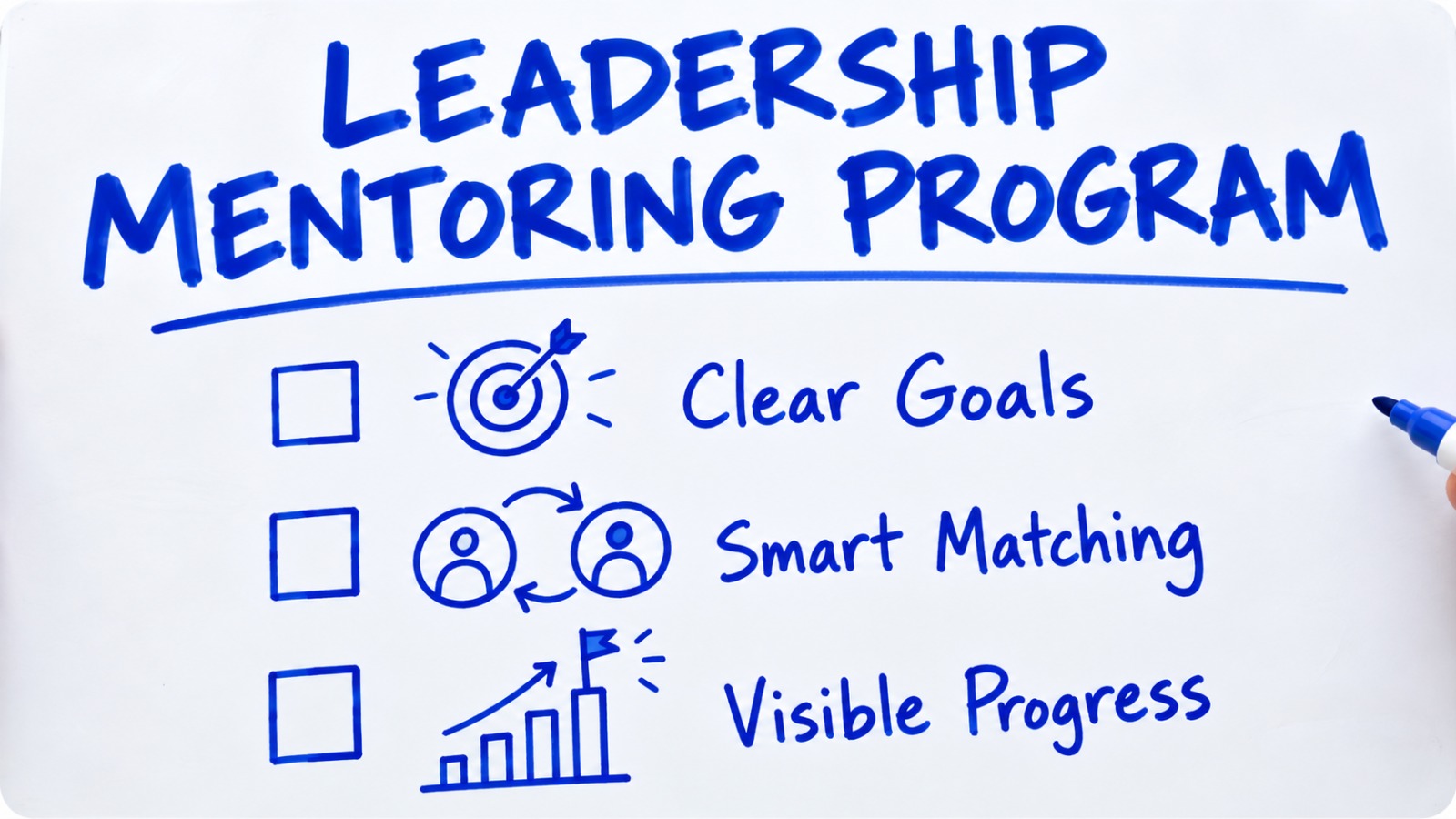
The lesson from the data isn't just "do mentoring." It's "do mentoring with structure" — clear goals, intentional matching, session frameworks, and measurement. That's the difference between the programs that produce the statistics above and the programs that quietly die. If you're evaluating tools for this, our comparison of the leading mentoring software platforms is a practical starting point.
Frequently asked questions
What percentage of companies have mentoring programs?
Estimates range from roughly 70% to 98% of Fortune 500 companies depending on the survey, with The Times reporting 97.5% (via Together). However, only about 37% of employees overall report currently having a mentor, revealing a large gap between program existence and actual access.
Does mentoring really improve employee retention?
Yes, and the effect is large. Enterprise program data shows retention of around 72% for mentees versus 49% for non-participants, Cox Automotive measured 79% versus 67% company-wide over two years, and Paychex reached 94% retention among women's mentoring participants — 14 points above its company average. See the employee retention and engagement use case for how organisations build programmes around this outcome.
Are mentors themselves promoted more often?
Yes. The well-known Sun Microsystems study found mentors were 6x more likely to be promoted — an even higher multiple than mentees, who were 5x more likely. Mentoring develops leadership capability in both directions. See our explainer on mentor vs mentee roles for how each party benefits.
How does mentoring affect employee engagement?
Strongly. Employees with mentors are twice as likely to be engaged at work (Gallup), and businesses with highly engaged employees are 18% more productive and 23% more profitable (Gallup).
How does mentoring compare with other DEI initiatives?
Mentoring is one of the strongest-performing DEI interventions on record. Research published in Harvard Business Review found it lifted minority representation in management by 9 to 24%, while many other diversity initiatives showed weak or even negative effects. See the diversity, inclusion and belonging use case for programme design guidance.
What makes a mentoring program actually deliver these results?
Structure. The programs behind these statistics share common traits: intentional (often algorithmic) matching, defined goals, session frameworks, regular cadence, and measurement of participation and outcomes. Informal, spreadsheet-run programs rarely sustain engagement long enough to capture the benefits — which is the core problem mentoring software exists to solve.
How much does employee turnover cost?
Gallup estimates US businesses lose nearly $1 trillion annually to voluntary turnover, and McKinsey estimates disengagement alone costs a median-size S&P 500 company $228–355 million a year. Even modest retention improvements from mentoring translate into significant savings. For the full ROI calculation, see our guide on proving the mentoring business case to your CFO.
The numbers tell a consistent story: mentoring works, it works for both sides of the relationship, and it works best when it's structured and measured rather than left to chance. The organisations capturing these results aren't the ones with the best intentions — they're the ones that treat mentorship as real infrastructure, with the same rigour they'd apply to any system that drives retention, productivity, and leadership growth.
About Mentorgain
Mentorgain is a structured mentoring platform that helps organisations turn these statistics into their own outcomes — with intelligent matching, guided journeys, and analytics that show exactly what's working. See our pricing or get leadership buy-in to get started.Book a demo →




.webp)