.svg)
Why Employees Leave - And How Mentoring Makes Them Stay
September 8, 2026
Gauri Gokhale
The Retention Problem Is Getting Harder to Ignore
Every HR and L&D leader knows the pain. A high performer hands in their notice. The team scrambles. The exit interview reveals what everyone quietly knew — they didn't leave for money. They left because they felt stuck, unseen, or simply not invested in.
Employee attrition is one of the most expensive problems facing organisations today. In India, replacing a mid-level professional can cost anywhere between one and two times their annual salary when you factor in recruitment, onboarding, lost productivity, and the institutional knowledge that walks out the door with them. For larger organisations running lean HR teams, this is a chronic drain on both budget and culture.
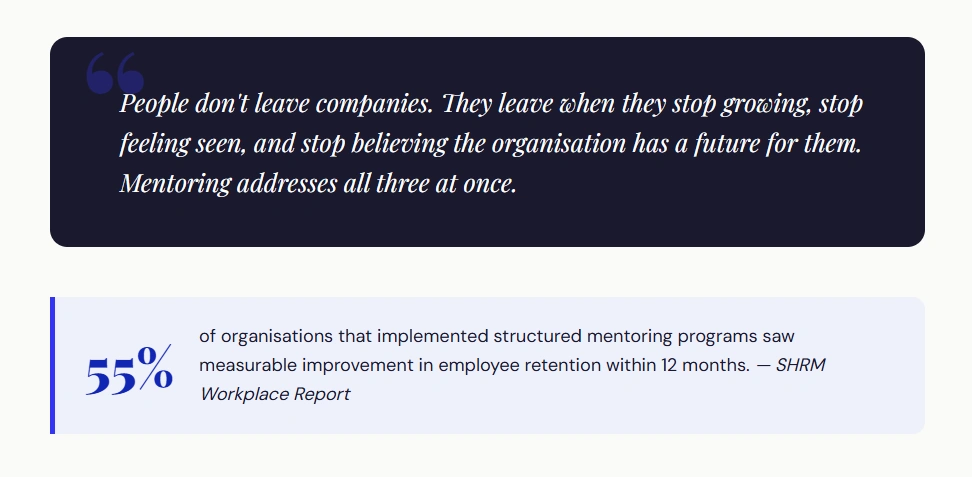
What's particularly frustrating is that most attrition is preventable. Research consistently shows that the top reasons employees leave aren't primarily about salary. They're about growth, belonging, and feeling like someone in the organisation is invested in their future. That's precisely where mentoring comes in.

Why Mentoring Retains Employees
Mentoring works on multiple levels simultaneously — and that's what makes it so effective as a retention tool. It isn't a single intervention. It's an ongoing relationship that continuously addresses the psychological and professional needs that keep people engaged.
It signals that the organisation is invested in their future
One of the most common reasons employees look elsewhere is the feeling that the organisation has no plan for them. A structured mentoring program sends a clear signal: we see you, and we're building a path forward with you. This alone can shift an employee's disposition from passive job-seeker to committed contributor.
It builds a sense of belonging and connection
Belonging is one of the strongest predictors of retention. Employees who feel connected to colleagues, especially across teams and hierarchies, are significantly less likely to leave. Mentoring creates exactly these kinds of meaningful cross-functional relationships — the kind you can't manufacture through a team lunch or a pulse survey.
It accelerates growth and prevents stagnation
Lack of growth is consistently cited as a top reason for leaving. A good mentor helps employees navigate career paths, build skills faster, and access opportunities they might not have found on their own. When people feel like they're moving forward, they stay.
It gives employees a sounding board during uncertainty
Organisations go through change — restructures, leadership transitions, market shifts. Employees without a trusted internal guide are far more likely to lose confidence and seek stability elsewhere. A mentor provides context, perspective, and continuity through those turbulent periods.
The Types of Mentoring That Drive Retention
Not all mentoring is created equal — and not every format works for every retention challenge. Here are the six types of mentoring that organisations should consider, and the specific retention problems each one solves.
One-on-One Mentoring
The classic format — a senior or more experienced employee paired with someone seeking guidance. Done well, it's the most powerful retention tool available. The mentor provides personalised career advice, helps the mentee navigate the organisation, and becomes an advocate for their development. Employees with a dedicated one-on-one mentor are significantly more likely to stay because they have someone with skin in their game.
Reverse Mentoring
In reverse mentoring, a junior employee mentors a senior leader — typically on technology, digital trends, or shifting cultural dynamics. This format does double retention duty: it keeps younger employees engaged by giving them visible influence and a sense of purpose, while simultaneously keeping senior leaders from disengaging as the world of work shifts around them. Organisations that invest in reverse mentoring find both ends of the seniority spectrum stay longer.
Onboarding & Buddy Mentoring
The first 90 days are the most critical period for employee retention. New hires who feel lost, overwhelmed, or disconnected during onboarding are far more likely to leave within the first year. Buddy mentoring pairs new joiners with a more tenured colleague who helps them understand the culture, navigate processes, and feel genuinely welcomed. Organisations with structured onboarding mentoring see dramatically lower early attrition — often 30 to 40% lower in the first year.
Group Mentoring & Mentoring Circles
Group mentoring brings a small cohort of employees together with one or two mentors for structured discussions, shared learning, and peer accountability. It's particularly effective in large organisations where one-on-one mentoring can't scale across thousands of employees. Mentoring circles build a sense of community, shared identity, and mutual investment that individual relationships alone can't create. Employees embedded in a mentoring community are less likely to feel isolated and more likely to stay.
Diversity & Inclusion Mentoring
Underrepresented groups — women, employees from non-dominant backgrounds, first-generation corporate professionals, and returning parents — face compounding barriers that generic mentoring programs don't address. Targeted D&I mentoring creates safe spaces for these employees to build confidence, access sponsorship, and navigate workplace dynamics that others may take for granted. Organisations that run intentional D&I mentoring programs consistently outperform peers on retention of diverse talent, which is often the hardest talent to retain.
HiPo & Succession Mentoring
High-potential employees are the most likely to be headhunted — and the most expensive to lose. Dedicated mentoring programs for HiPos signal that the organisation sees their potential and is actively preparing them for leadership. This kind of intentional investment is one of the most effective ways to retain your future leaders. When high-potential employees have a clear developmental path with mentoring support, they're far less likely to seek that path elsewhere.

Making Mentoring Stick: What Separates Programs That Work From Those That Don't
Most organisations understand the value of mentoring in theory. Far fewer run programs that actually deliver measurable retention outcomes. The difference comes down to structure, commitment, and the right infrastructure.
What effective mentoring programs have in common
Based on research and our experience working with organisations across India and APAC, here's what consistently makes the difference:

A Note for India & APAC Organisations
Employee retention in India operates in a distinct context. Career mobility is high, the talent market is competitive, and younger workforces are particularly attuned to whether their employers are actively investing in their growth. The cultural value placed on mentorship — guru-shishya relationships have been central to Indian professional and academic life for centuries — means that structured mentoring programs often land particularly well here.
Yet most mentoring software available today is built for Western enterprise contexts. The pricing is prohibitive for many Indian organisations, the customisation is rigid, and the support is routed through time zones that don't serve APAC teams.
Mentorgain was built specifically for this gap. We offer structured mentoring programs with smart matching, milestone tracking, real-time analytics, and hands-on program support — at pricing and with a service model that makes sense for India and APAC organisations.
Whether you're running a 200-person organisation or scaling across 5,000 employees, a well-designed mentoring program can be one of your most powerful tools for keeping the people you can't afford to lose.
Ready to build a mentoring program that retains your best people?
Mentorgain helps India and APAC organisations design, launch, and run structured mentoring programs — with the support, customisation, and pricing that actually works for your context.
Book a Demo →





.webp)