DEI Statistics and Trends Every HR Leader Should Know

Research checked October 21, 2026
A promotion review can look fair on paper while the same employees keep missing out on the experience needed to qualify. That is why useful DEI statistics go beyond counting who works at your company. They help you ask who gets support, who progresses and where access breaks down.
The research offers a practical starting point. Women remain underrepresented in senior leadership, disability employment gaps persist, and employee attitudes toward DEI are mixed. For HR leaders, the priority is to connect those findings with decisions about development, advancement and everyday work.
This guide brings together selected research available as of October 21, 2026. Each figure keeps its original reporting year and geographic scope. Use the findings to frame questions for your organization, rather than treating them as universal performance targets.
What DEI means in the workplace
DEI stands for diversity, equity and inclusion. Diversity describes the range of backgrounds and experiences in a workforce. Equity concerns fair access to resources and opportunities. Inclusion concerns whether employees can contribute, feel respected and participate in decisions that affect their work.
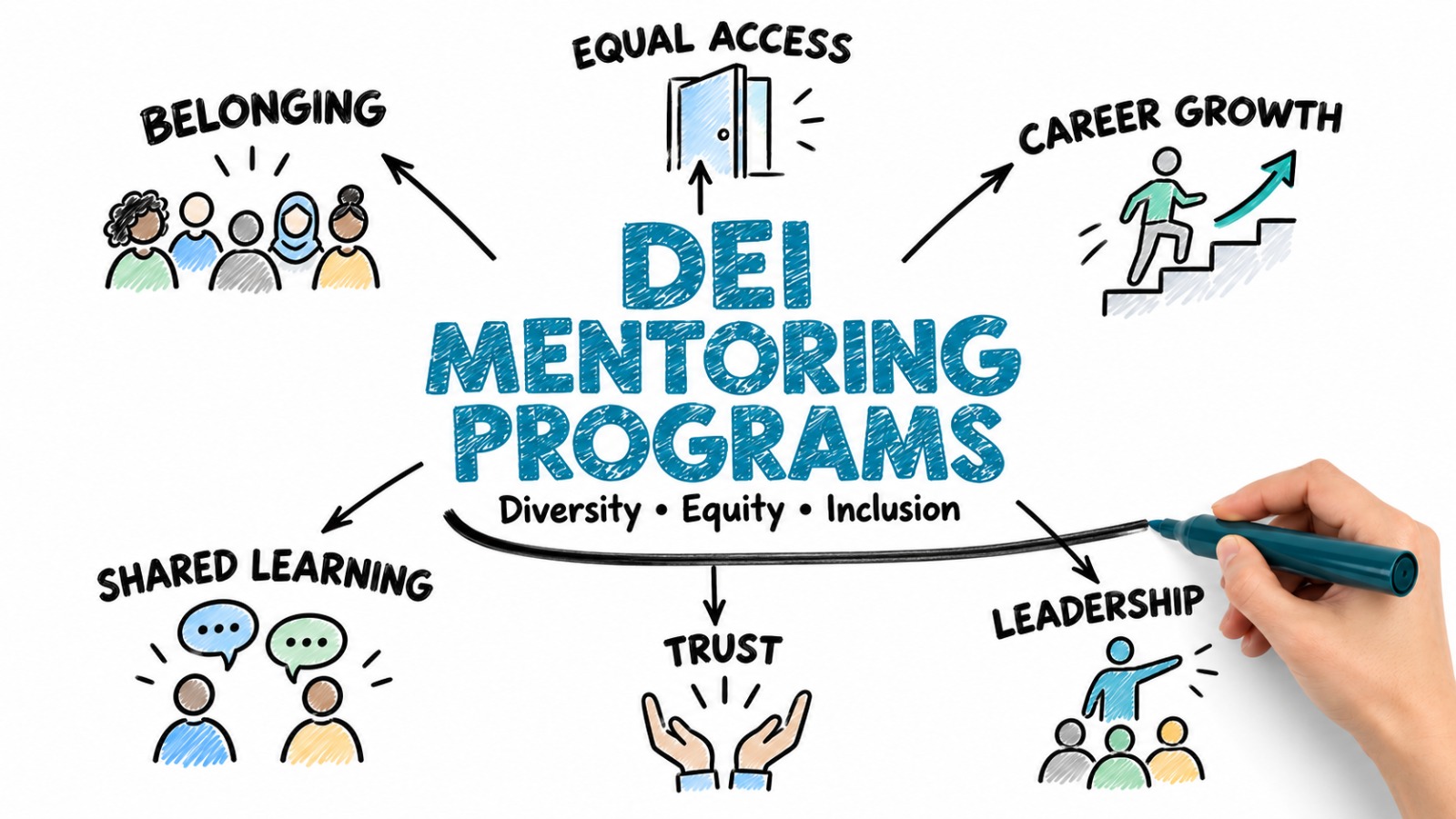
These ideas overlap, but they need different measures. A diverse hiring cohort does not tell you whether those employees receive useful feedback or reach management. Our guide to what DEI means and how mentoring can help explains how structured development fits into that wider picture.
DEI statistics at a glance
The figures below describe different populations. Read the scope alongside the number before using it in a presentation or business case.
| Statistic | Scope and year | Source |
|---|---|---|
| 93 women and 74 women of color promoted for every 100 men | First promotion to manager in participating companies, 2025 | McKinsey and LeanIn.Org |
| 29% of C-suite roles held by women | Participating companies, 2025 | McKinsey and LeanIn.Org |
| 69.2% of the overall gender gap closed | 145 economies, 2026 index | World Economic Forum |
| 38.1% versus 74.8% employed | US people aged 16 to 64, with versus without a disability, 2025 | BLS |
| 52% viewed increasing DEI at work positively | Eligible US workers, October 2024 | Pew Research Center |
The first promotion still deserves closer attention
In the 2025 Women in the Workplace study, 93 women advanced to manager for every 100 men. For women of color, the figure was 74. Women held 29% of C-suite positions in participating companies. McKinsey and LeanIn.Org collected pipeline data from 124 organizations employing roughly three million people. The authors note that the sample overrepresents companies with stronger female representation.
The HR question is specific: what happens before someone becomes eligible for their first management role?
Look at who receives acting manager assignments, project ownership, client exposure and coaching. If those opportunities depend on informal nominations, publish the selection criteria and invite employees to express interest. Review who was considered as well as who was selected.
Mentoring can help employees prepare for this step. Sponsorship adds advocacy, such as recommending someone for a visible assignment. Neither removes the need to inspect promotion decisions. Mentorgain’s leadership mentoring program guide offers a starting point for structuring development around the move into management.
Global progress needs a local reading
The World Economic Forum’s Global Gender Gap Report 2026 reports that 69.2% of the overall gender gap is closed across 145 economies. Its Economic Participation and Opportunity subindex stands at 61.7%.
Those are index scores, not the percentage of women employed or the share of employers with equitable practices. The overall index covers education, health, economic participation and political empowerment. It provides context for workforce planning, but it cannot diagnose an individual employer.
For teams operating across India, APAC and other regions, build separate local views. Compare similar job families and career levels. Ask whether language, location, shift patterns or access to senior colleagues affects development opportunities. A company average can hide a location where employees rarely meet anyone who can help them progress.
The practical lesson is to combine a common standard for fair opportunity with an understanding of local barriers. A mentoring format that works for headquarters may need a different meeting rhythm for frontline employees.
Disability inclusion requires attention to the whole employee journey
US Bureau of Labor Statistics data show that 22.8% of people with a disability were employed in 2025, compared with 65.2% of those without a disability. These figures cover people aged 16 and older. The older age profile of the population with disabilities partly affects the comparison.
Among people aged 16 to 64, the corresponding figures were 38.1% and 74.8%. The BLS release and tables also explain that the 2025 annual estimates exclude October because data were not collected during the federal government shutdown. They are not strictly comparable with other annual averages.
For an employer, the next step is to inspect access. Can candidates complete the application process with assistive technology? Can employees request adjustments without repeatedly explaining personal circumstances? Are learning materials, mentoring sessions and internal job applications accessible?
Include employees with disabilities in that review. A completion rate will tell you that someone finished a learning module. It will not tell you how much additional effort the format required.
Employee support for DEI cannot be taken for granted
In Pew Research Center’s October 2024 survey, 52% of eligible US workers said increasing DEI at work was mainly a good thing, compared with 56% in February 2023. The share viewing it as mainly a bad thing rose from 16% to 21%. The Pew analysis used responses from 4,367 workers employed at organizations with at least 10 people, subject to its employment criteria.
This is a dated US sentiment measure, not a reading of every workforce in 2026. It does, however, give HR leaders a reason to explain programs in concrete terms.
Employees should understand the problem being addressed, how participation works and how decisions are made. “We are making development opportunities easier to find” gives people something they can assess. A broad promise to transform culture is harder to evaluate.
Listen to questions about fairness and follow through when a process is unclear. Clear eligibility criteria, visible application routes and honest reporting help people understand what a program actually does.
Four DEI priorities to watch
The research above points to four practical priorities. These are recommendations for HR teams, rather than a claim that every employer is adopting the same approach.
Measure opportunity alongside representation
Headcount is a starting point. Add measures of access to mentoring, manager feedback, stretch assignments and internal vacancies. Then review whether access translates into progression. This helps distinguish a recruitment problem from a development or promotion problem.
Make development less dependent on existing networks
Ask employees how they found their last useful career opportunity. If the answer is usually a private introduction, make more routes visible. Open applications, published criteria and structured mentoring can help employees build connections outside their immediate teams.
Treat inclusion as part of management practice
Ask managers to explain how work is allocated, how feedback is delivered and how readiness for advancement is assessed. Give them time and guidance to improve those routines. An annual inclusion survey becomes more useful when someone owns the action that follows.
Evaluate programs beyond attendance
Attendance can establish that a program ran. To judge whether it helped, collect a baseline and measure the outcome it was designed to influence. For mentoring, review relationship quality and goal progress before expecting a change in retention or promotion.
A DEI scorecard HR leaders can use
Choose a small set of measures that will change a decision. Define each denominator, timeframe and data source before collecting results.
| Measure | What to review |
|---|---|
| Representation by level | Workforce composition at each career level and location |
| Promotion rate | Employees promoted divided by employees eligible in the same period |
| Development access | Share of eligible employees receiving the defined opportunity |
| Mentoring activation | Confirmed pairs completing a first session within a set window |
| Inclusion feedback | Consistent questions about voice, respect and access to support |
| Voluntary turnover | Voluntary exits relative to the defined workforce population |
Read the measures together. Strong mentoring enrollment with weak activation may signal scheduling problems. Strong participation with poor feedback may point to a mismatch between the program design and employee needs.
For promotion rates, divide the number promoted by the eligible population in each group over the same period. Suppose 12 of 100 eligible employees in one group advance, compared with 24 of 120 in another. The rates are 12% and 20%, a gap of eight percentage points. This is an illustrative example, not a benchmark. Investigate role mix, tenure and the decision process before drawing a conclusion.
Use the same care with retention. People who volunteer for mentoring may differ from nonparticipants before the program starts. A difference in outcomes does not, by itself, prove that mentoring caused it. Mentorgain’s guide to mentoring program metrics and KPIs explains how to combine activity, development and talent measures.
Protect confidentiality when reviewing results. Use voluntary demographic disclosure where appropriate, restrict access and avoid reporting small groups in ways that identify individuals. Do not use private mentoring conversations as performance evidence.
How mentoring can turn DEI findings into practical action
Start with a problem you can describe clearly. Perhaps employees outside headquarters struggle to build senior networks. Perhaps potential first-time managers want guidance but do not know whom to approach.
Design a focused pilot around that need. Invite participants through visible channels, explain the time commitment and match people around development goals and relevant experience. Provide a first-session agenda and a way to request a different match.
Mentorgain’s DEI mentoring programs support approaches including ERG mentoring, cross-cultural pairs, reverse mentoring and sponsorship. The platform provides matching, guided sessions, goal tracking and feedback to help teams run a consistent program. For a step-by-step build, read our complete guide to DEI mentoring programs.
Agree on the review before launch. During the first month, check whether relationships have started. At the midpoint, ask whether conversations are useful and whether participants need support. At the end, review progress against the goals you set. Assess longer-term talent outcomes separately, allowing time for them to emerge.
Mentoring should sit alongside fair hiring, accessible work, clear promotion criteria and effective management. It gives employees a structured route to guidance. Its value depends on the quality of that experience and the opportunities available afterward.
Frequently asked questions
Which DEI statistics should HR leaders track first?
Start with representation by level, promotion rates among eligible employees, voluntary turnover, access to development and employee inclusion feedback. Choose measures linked to a specific workforce problem and compare groups over a consistent period.
Are diversity and inclusion measured in the same way?
No. Representation measures describe workforce composition. Inclusion measures examine employee experience, such as whether people feel heard, respected and able to contribute. Use both, because one cannot establish the other.
What is a good DEI benchmark?
A useful benchmark matches your geography, industry, job levels and metric definition. National statistics and research samples provide context. Your own baseline shows whether a specific process is improving. No single percentage establishes that a workplace is inclusive.
Can mentoring improve DEI outcomes?
Mentoring can widen access to guidance and professional networks when participation and matching are thoughtfully designed. Evaluate relationship quality, development progress and relevant talent outcomes. Do not assume that enrollment alone proves an improvement in equity or inclusion.
How often should DEI data be reviewed?
A practical starting point is a quarterly review of workforce outcomes, with more frequent checks during a program launch. Use consistent definitions and allow enough time for meaningful changes. Review employee feedback between formal reporting cycles when it identifies a problem that needs action.
Give the numbers a next step
Choose one barrier the data helps you see, name the person responsible for addressing it and agree when to review progress. That makes a statistic useful to employees as well as leadership.
If access to guidance is the issue, explore a DEI mentoring program with Mentorgain. Start with a clear need, a manageable cohort and an honest measure of success.