.svg)
Leadership Mentoring Program: How to Design One That Builds Real Leaders
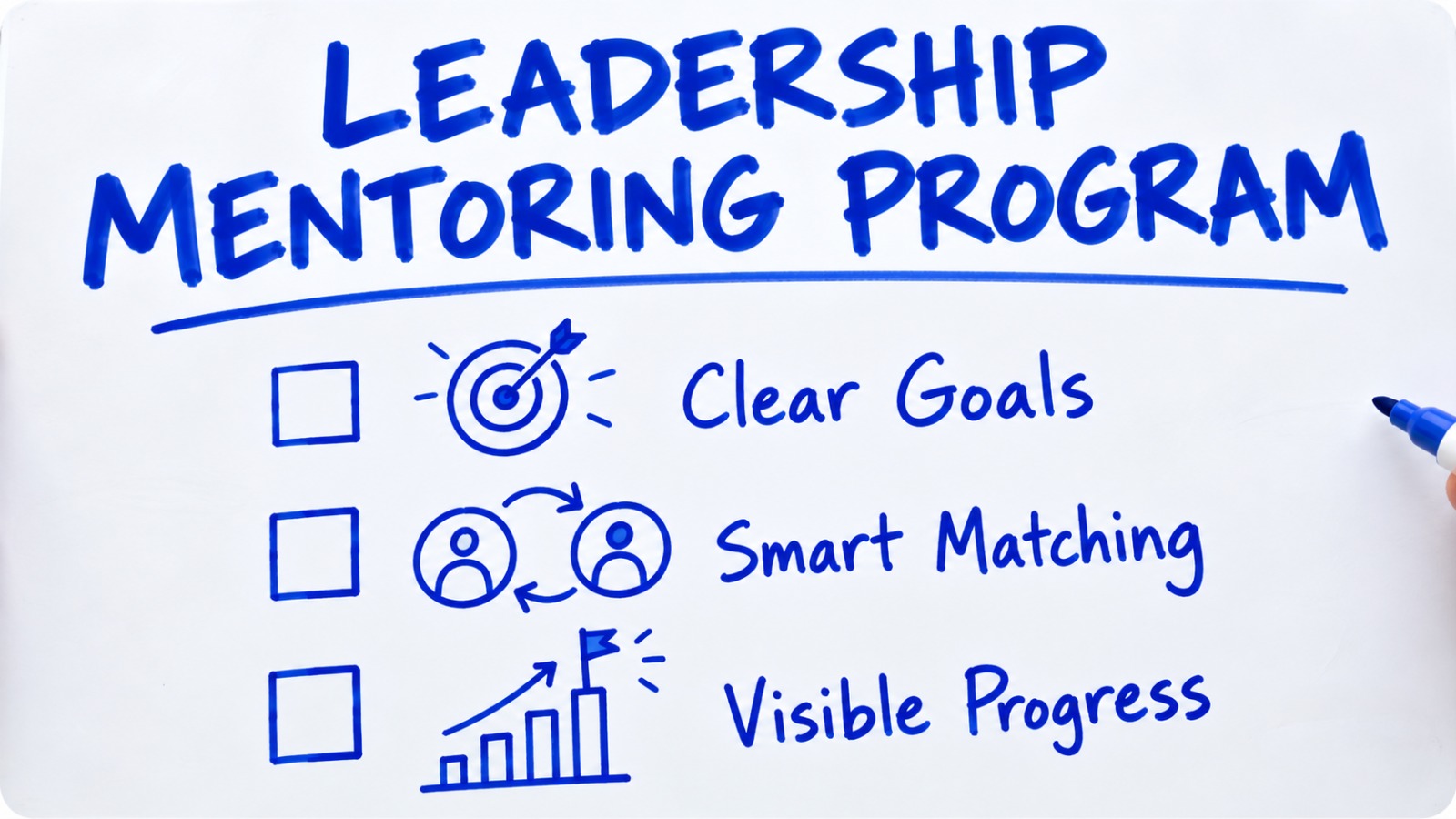
Quick answer: A leadership mentoring program pairs emerging and current leaders with experienced mentors to build the judgment, relationships and confidence that training alone cannot provide. A strong program:
- Has a clear purpose, such as preparing first-time managers or readying high-potential employees for bigger roles.
- Matches each mentee with a senior mentor outside their reporting line, based on goals and skills.
- Runs for a fixed term, usually six to twelve months, with sessions every two to four weeks.
- Gives each pair a simple structure: development goals, session agendas and a midpoint review.
- Tracks outcomes such as readiness for promotion, retention and engagement, not just attendance.
Most organizations do not have enough ready leaders. In DDI's Global Leadership Forecast 2025, only 47% of critical roles could be filled by current leaders, and the share of high-potential employees planning to leave rose from 13% in 2020 to 21% in 2024.
A leadership mentoring program is one of the most practical ways to close that gap. It gives future leaders access to people who have already handled the decisions they are about to face. This guide shows HR and L&D teams how to design, launch and measure one.
What Is a Leadership Mentoring Program?
A leadership mentoring program is a structured initiative in which experienced leaders mentor employees who are preparing for, or are new to, leadership responsibilities. Unlike a classroom course, it develops leaders through a relationship: regular conversations about real situations, feedback on decisions and access to the mentor's network.
Most programs serve one or more of these groups:
- Emerging leaders who show potential but do not yet manage people.
- First-time managers in their first 12 to 18 months of leading a team.
- Mid-level leaders moving into larger, cross-functional or strategic roles.
- Senior leaders who benefit from peer or executive mentoring, or from reverse mentoring with younger colleagues.
Leadership Mentoring vs. Coaching vs. Training
These approaches work best together, but each one does a different job:
| Leadership mentoring | Executive coaching | Leadership training | |
|---|---|---|---|
| Led by | An experienced internal leader | A trained, often external, coach | A facilitator or course |
| Focus | Judgment, perspective, relationships and career direction | Specific behaviors or performance goals | Shared skills and frameworks |
| Format | One-to-one or small group, over months | One-to-one, a set number of sessions | Group sessions or online modules |
| Cost | Low per person; mentors give their time | High per person | Medium; scales to many people |
| Best for | Building many leaders at once and passing on company knowledge | A few senior leaders with clear development needs | Giving every manager the same baseline |
For a fuller comparison of these roles, read mentoring vs coaching vs buddy vs sponsorship.
Why Leadership Mentoring Programs Work
- They transfer judgment, not just knowledge. A mentor can explain how they handled a difficult restructuring or a failed launch, which no course can replicate.
- They speed up the transition into management. First-time managers get a safe place to talk through feedback conversations, delegation and conflict before they become problems.
- They build cross-functional networks. Pairing mentees with leaders from other departments gives them a wider view of the business.
- They help retain high-potential employees. Visible investment in someone's growth gives them a reason to build their career with you.
- They develop the mentors too. Senior leaders sharpen their coaching skills and hear what is happening further down the organization.
How to Design a Leadership Mentoring Program
- Define the purpose and audience. Pick one main goal for the first cohort, such as "prepare 30 high-potential individual contributors for their first management role." A narrow goal makes matching, content and measurement much easier.
- Get an executive sponsor. A senior leader who opens the program, recruits mentors and asks about progress signals that leadership development matters.
- Recruit and prepare mentors. Look for leaders who listen well and are willing to share mistakes, not only the most senior titles. Give them a short orientation on expectations, confidentiality and good questions. Our mentor training program guide includes a ready-made curriculum.
- Choose a mentoring model. One-to-one mentoring suits deep development; group mentoring lets one senior leader support several emerging leaders; reverse mentoring helps senior leaders learn from newer employees. Many programs combine two.
- Match with care. Pair mentees with mentors outside their reporting line, based on development goals, skills and the experience the mentee needs. Automated mentor matching makes this practical for larger cohorts.
- Give each pair a structure. Ask each mentee to set two or three SMART development goals, share a suggested session rhythm and provide session agendas and questions so conversations stay focused.
- Plan how you will measure success. Decide on your outcome metrics before launch so you can collect a baseline.
A 90-Day Plan to Launch a Leadership Mentoring Program
You do not need a year of planning to start. This timeline works for a first cohort of 20 to 50 pairs:
| Phase | Weeks | Key actions |
|---|---|---|
| Plan | 1–3 | Agree on the goal, audience and sponsor. Choose the model, program length and success metrics. |
| Recruit | 4–6 | Invite mentors and nominate or open applications for mentees. Collect goals, skills and preferences. |
| Match and prepare | 7–8 | Match pairs, then run a short mentor orientation and a mentee kickoff. |
| Launch | 9–10 | Pairs hold their first session, agree on goals and set a meeting rhythm. |
| Support and review | 11–13 | Send reminders and conversation prompts, check which pairs are active and step in where pairs have stalled. |
For a general launch checklist, see our step-by-step guide on how to launch a mentorship program.
Topics to Cover in Leadership Mentoring Sessions
Good sessions start from the mentee's real challenges. These topics come up in most leadership mentoring relationships:
- Moving from individual contributor to manager, and letting go of doing the work yourself.
- Giving difficult feedback and handling underperformance.
- Delegating, prioritizing and protecting time for strategic work.
- Making decisions with incomplete information.
- Managing up and building relationships with peers in other functions.
- Leading through change, uncertainty or a restructuring.
- Building a personal leadership style and a long-term career plan.
How to Measure a Leadership Mentoring Program
Track a mix of activity and outcome measures, and compare participants with a similar group that did not take part where you can:
| Metric | What it shows |
|---|---|
| Session frequency and pair activity | Whether relationships are actually happening |
| Goal progress (mentee and mentor ratings) | Whether mentees are building the skills they set out to build |
| Leadership readiness ratings | How managers or talent reviews rate participants' readiness for a bigger role |
| Promotion and internal move rates | Whether the program is filling leadership roles from inside |
| Retention of participants | Whether high-potential employees are staying |
| Participant satisfaction | Whether mentors and mentees would recommend the program |
Our guide to mentoring program KPIs explains how to set up each measure.
Common Leadership Mentoring Mistakes to Avoid
- Choosing mentors by title alone. The most senior person is not always the best mentor. Look for openness, listening skills and time to commit.
- Pairing mentees with their own manager. Mentees are less likely to discuss doubts or career moves with the person who rates their performance.
- Launching without structure. Without goals and agendas, sessions drift into general catch-ups and pairs stop meeting.
- Measuring attendance only. Count outcomes such as readiness and retention, not just the number of sessions.
- Leaving pairs alone after the kickoff. Check in at the midpoint and help stalled pairs restart. Our guide on why mentoring relationships fail covers the warning signs.
How Mentorgain Supports Leadership Mentoring Programs
Mentorgain helps HR and L&D teams run leadership mentoring at scale. Mentor matching pairs emerging leaders with the right senior mentors based on goals and skills. Structured mentoring journeys give each pair clear milestones, and session tracking shows which relationships are active. Group sessions let one senior leader mentor several emerging leaders at once. Learn more about our mentoring software.
If your goal is to prepare successors for specific critical roles, see our guide to building a leadership pipeline through mentoring.
Leadership Mentoring Program FAQs
What is a leadership mentoring program?
A leadership mentoring program is a structured initiative that pairs emerging or current leaders with experienced mentors to build leadership skills, judgment and networks through regular one-to-one or group conversations.
How long should a leadership mentoring program last?
Most programs run for six to twelve months, with sessions every two to four weeks. That is long enough for mentees to work on real leadership challenges and show progress.
Who should be a mentor in a leadership mentoring program?
Choose experienced leaders who listen well, share their own mistakes openly and can commit time. Mentors should sit outside the mentee's reporting line.
How is leadership mentoring different from executive coaching?
Leadership mentoring is led by an experienced internal leader and focuses on judgment, perspective and career growth. Executive coaching is usually delivered by a trained coach and focuses on specific behaviors or performance goals.
How do you measure the success of a leadership mentoring program?
Track session activity and goal progress, then measure outcomes such as leadership readiness ratings, promotion and internal move rates, retention of participants and satisfaction.
Building your next generation of leaders?
See how Mentorgain helps HR and L&D teams match, guide and measure leadership mentoring programs. Talk to our team.





.webp)