
How to Prepare Junior Employees to Be Reverse Mentors
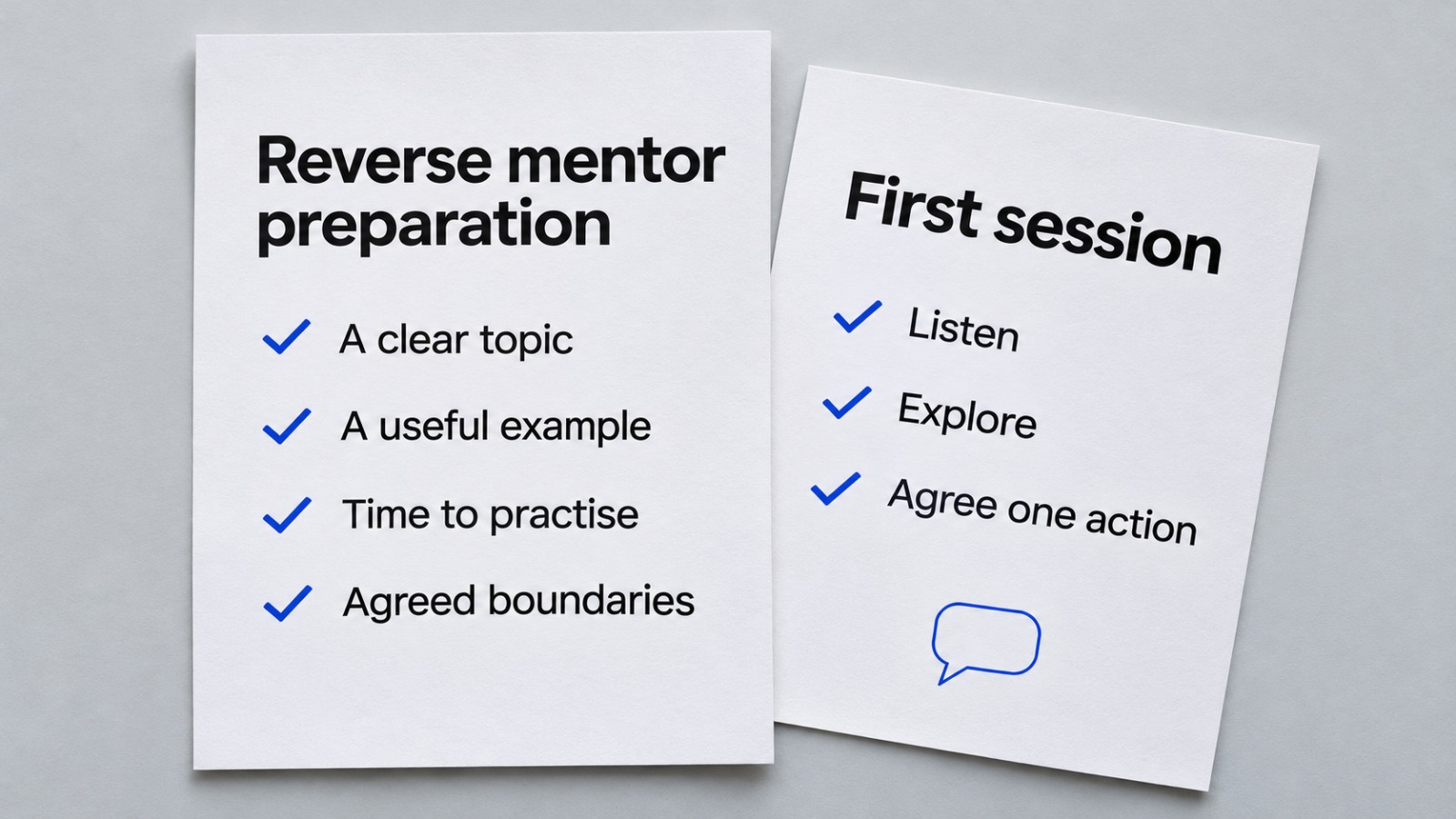
To prepare junior employees to be reverse mentors, agree on one topic they know well, explain the boundaries of the role, give them time to rehearse, and prepare senior leaders to listen. Before the first meeting, every mentor should have a learning goal, a simple agenda and a named contact outside the pairing.
Knowing something useful and feeling comfortable teaching it to a senior leader are different things. An analyst may be happy to show a teammate a new workflow, then become much more cautious when the learner is a director who influences their career.
For HR and L&D teams, preparation means addressing that difference. This guide gives you a practical training plan, sample language and a readiness checklist you can adapt before your first cohort meets.
What does a junior reverse mentor actually do?
A junior reverse mentor helps a senior colleague learn from expertise or experience the colleague does not have. The topic might be an approved AI workflow, an onboarding process or how frontline employees use internal communications. Seniority describes the organisational relationship, not who knows more about everything.
The mentor shares examples, asks questions and helps the leader try a different approach. They are not there to represent an entire generation, disclose personal experiences or solve problems that belong to management. For the wider program design, see our reverse mentoring guide and pilot plan.
A useful starting brief is: “You will help your senior colleague understand one agreed topic through examples from your work. You can decline questions, ask for support or request a different match.”
Why preparation needs to address power as well as confidence
A confident presentation does not tell you whether an employee feels free to disagree. Someone may deliver a polished demonstration while avoiding the point the leader most needs to hear.
In a BMJ Open feasibility study published on 15 November 2022, researchers examined reverse mentoring involving six junior doctors and five consultants. Participants initially raised concerns about hierarchy and selection. Junior mentors reported greater confidence giving feedback after the process. This was a small clinical study, so it cannot establish what a workplace program will achieve. It does show why hierarchy belongs in the preparation conversation.
Explain how concerns will be handled before you ask employees to speak openly. Wherever possible, avoid matching a mentor with someone who directly controls their performance assessment. Offer a private way to decline a proposed pairing, without requiring the employee to explain their concern to the senior participant.
Prepare junior reverse mentors in six steps
1. Agree on a useful learning goal
Start with what the senior participant wants to understand or do differently. Then check that the junior mentor has relevant experience and wants to share it.
“Teach me about Gen Z” gives the mentor too much to interpret. “Help me understand where new hires struggle to find reliable information during onboarding” gives the pair a place to start.
Ask the mentor what they want from the experience too. They might want practice explaining technical work, a better understanding of leadership decisions or exposure to a different business function. Record that goal without promising promotion or special access beyond the program.
2. Protect the time and narrow the topic
Agree how much working time participants can use for preparation and sessions. Ask their managers to account for that commitment when allocating work.
One example is enough for the first meeting. An employee teaching an AI workflow could bring a demonstration using approved tools and sample data. Someone discussing onboarding could bring a fictional new starter journey. Neither needs to create a full training course.
Write down what falls outside the topic. For an AI session, that includes which tools and data are permitted. For an inclusion session, let the mentor choose which experiences they are comfortable discussing. Personal disclosure is optional.
3. Explain boundaries and the support route
Give both participants a short agreement covering the purpose, meeting schedule, cancellation process, information sharing and withdrawal options.
Be specific about what HR receives. Attendance, agreed goals and feedback about program support may be useful. Detailed accounts of private conversations usually require a different justification and clear participant understanding.
Do not promise absolute confidentiality. Explain any exceptions under your organisation's policies, who handles concerns and how participants can reach that person. Keep formal complaints and reporting processes available outside mentoring.
A mentor should be able to say: “I can explain my own experience, but I cannot speak for everyone,” or “I would prefer not to discuss that example. Can we use a different one?”
4. Run a practical preparation workshop
Use the following 75-minute workshop as a starting design, not a research-backed minimum. Add support when the topic or participants need it.
- First 10 minutes: explain the purpose, roles and what useful progress could look like.
- Next 15 minutes: review boundaries, support contacts and how to pause or change a match.
- Next 15 minutes: help each mentor turn their topic into one example and two discussion questions.
- Next 25 minutes: rehearse opening a session, answering an unfamiliar question and responding to disagreement.
- Final 10 minutes: review the first-session agenda and collect questions privately.
Offer a written rehearsal or a smaller practice conversation for employees who prefer it. Readiness should depend on whether someone can share useful knowledge with support, rather than how confidently they perform in front of a group.
5. Practise the moments that are likely to feel awkward
Rehearse situations, not just introductions. Ask a colleague to play the senior learner and try these responses in the mentor's own words.
If the leader makes a broad assumption: “My experience has been different. Could I show you what happens in our team?”
If the mentor does not know the answer: “I haven't tested that, so I don't want to guess. Let's note it as a question to check.”
If the meeting turns into career advice: “That would be helpful another time. Could we finish the workflow we agreed to explore today?”
If the leader becomes defensive: “I'm describing what I observed. Would it help to walk through the example together?”
The mentor does not have to resolve every difficult response. Practise ending a conversation and contacting the program owner too. Repeated dismissal or pressure needs intervention from the person responsible for the program.
6. Check readiness privately before the first meeting
Ask the mentor to explain the topic, the opening question and what they would do if the conversation became uncomfortable. Check that the senior participant has accepted the same boundaries.
If either person is uncertain, offer another rehearsal or adjust the topic. Avoid treating the check as a pass or fail assessment. Its purpose is to find support needs before a difficult situation occurs.
Prepare senior leaders to be learners
A mentor cannot compensate for a leader who interrupts, cancels repeatedly or treats the session as an evaluation. Give senior participants their own briefing before matching begins.
Ask them to arrive with a learning question, listen to the example before responding and try one agreed action between meetings. They should ask permission before attributing an insight to the mentor or sharing the conversation elsewhere.
Cisco's program account, accessed on 23 November 2026, describes preparation materials for mentors and separate midpoint check-ins for mentors and mentees. That offers a useful operational example: support both roles throughout the relationship.
A good opening from a senior learner is simple: “I want to understand how this works from your perspective. You can tell me when my assumptions do not fit your experience.” Their response to the first disagreement matters more than the invitation itself.
Give every pair a simple first session agenda
For a 45-minute first meeting, try this structure:
- 5 minutes to introduce the learning goal and what each person hopes to gain.
- 10 minutes to agree boundaries, dates and how to handle cancellations.
- 15 minutes for the mentor to share one example or demonstration.
- 10 minutes for questions and discussion about how the learning applies.
- 5 minutes to agree one action and the next meeting topic.
Keep notes focused on agreed actions. Do not record sessions by default. An action could be testing a clearer onboarding message or practising a workflow with sample data. At the next meeting, start by asking what happened.
Check whether preparation is working
After the first session, contact mentors and senior learners separately. Ask whether the topic was clear, whether they could ask questions freely and whether the preparation helped. Give participants a private channel alongside any survey.
At the midpoint, look for evidence of applied learning. Ask the leader what they tried and the mentor whether the conversation stayed within the agreed boundaries. Track missed sessions and unresolved support requests as well as completed meetings.
A busy calendar is not proof of a useful program. Equally, a small pilot cannot establish a retention effect. Use early feedback to improve the experience and collect concrete examples of changed practice with permission.
A readiness checklist for HR and L&D
Before the first meeting, confirm that:
- Both people have volunteered and accepted the proposed match.
- The pair has one specific topic and a learning goal.
- Preparation and meeting time are protected within working hours.
- The mentor has rehearsed an example and a difficult response.
- The senior learner understands their responsibilities.
- Both participants know what information HR receives.
- A named program owner can arrange support, a pause or a rematch.
- The first meeting is booked and a private check-in is scheduled.
If something is missing, fix that part before the pair begins. An extra week of preparation is more useful than asking a junior employee to improvise around an unclear commitment.
How Mentorgain can support your reverse mentoring pilot
Preparation becomes harder to coordinate as you add pairs, topics and follow-ups. Mentorgain provides matching tools, mentoring journeys and tasks, and reporting and surveys to help teams organise the work around mentoring conversations.
Use a demo to assess how those capabilities fit your proposed cohort. Bring a learning theme, an approximate number of pairs and the preparation challenge you want to solve. You can then discuss how to organise matching, session preparation and feedback in one program.
Book a Mentorgain demo to discuss your reverse mentoring pilot. If you are still shaping the idea, start with the leader behaviour you want to change. You do not need a finished program plan to get in touch.
Frequently asked questions
How much training do junior reverse mentors need?
Start with a focused preparation workshop and a rehearsal before the first session. The 75-minute plan above is a suggested format. Sensitive topics, unfamiliar tools or concerns about the match may require more time and individual support.
Do junior employees need to be experts to become reverse mentors?
They need relevant experience in the agreed topic and enough understanding to explain an example honestly. They do not need to know every answer. Make it acceptable to say they are unsure and check a question later.
What if a junior mentor is nervous about challenging a senior leader?
Offer practice, narrow the first topic and check the pairing privately. Prepare the leader to receive disagreement. If the concern involves how the leader may react, address that concern before proceeding with the match.
Should reverse mentoring participation be mandatory?
Invite volunteers and explain the commitment before they join. Employees should be able to decline, pause or request another match. A required conversation can make it harder to distinguish willing participation from compliance.
How can HR support the program without monitoring private conversations?
Track agreed program information such as meeting completion, goals and support needs. Explain who sees it and why. Collect private feedback separately, and avoid requiring detailed conversation notes as evidence of participation.