How to Build an Employee Mentoring Programme in the UAE
November 26, 2026
Gauri Gokhale
An employee mentoring programme in the UAE starts with a clear development goal, a focused group of participants and a practical plan for matching, supporting and measuring mentoring relationships. Begin with a pilot, prepare mentors and mentees, protect time for regular conversations and review progress before expanding.
The challenge usually comes after the introductions. Two people are matched, an enthusiastic launch email goes out, and both return to busy calendars. Without clear expectations, the relationship can become another meeting that keeps getting postponed.
A useful programme makes the next step obvious. Participants know why they have been matched, what they are working towards and where to ask for help.
For UAE employers, that structure can support several priorities: developing Emirati talent, helping new employees settle in, preparing first-time managers and sharing knowledge across departments.
What is an employee mentoring programme?
An employee mentoring programme is a structured arrangement in which employees learn from colleagues through regular conversations, practical guidance and agreed development goals.
A mentor might help an employee prepare for management responsibilities, understand another business function or work through a difficult stakeholder conversation. The mentee brings questions, reflects on feedback and applies what they learn.
Mentoring also serves a different purpose from day-to-day management.
| Role | Main responsibility | Example |
|---|---|---|
| Line manager | Sets priorities, manages performance and provides work-related support | Reviews progress against quarterly objectives |
| Onboarding buddy | Helps a new employee navigate everyday working life | Explains systems, routines and whom to contact |
| Mentor | Supports learning, perspective and longer-term development | Helps an employee practise influencing senior stakeholders |
One person may sometimes fulfil more than one role. For a formal programme, however, giving employees access to someone outside their reporting line can create space for a different kind of conversation.
Why is mentoring relevant to UAE employers?
Mentoring offers a practical way to connect employee development with everyday work. It gives people someone to turn to when a course has finished but the real challenge is still ahead.
There are also established local examples.
In its announcement dated 28 April 2025, Emaar described how Focused Mentorship 3.0 allows mentees to choose mentors based on their learning needs, career aspirations or project requirements. Its approach combines mentoring with activities such as learning labs and on-the-job exposure. Emaar, April 2025
Emirati career development is another relevant context. Nafis, launched in 2021, identifies skills, experience and career progression as part of its mission to support Emiratis in private-sector careers. An employer's mentoring programme can complement those development priorities through regular guidance and practical learning. Emirati Talent Competitiveness Council, accessed 26 November 2026
How do you build an employee mentoring programme in the UAE?
Build the programme around eight decisions: its purpose, ownership, participants, format, matching, preparation, delivery and measurement.
1. Choose one clear business and employee need
“Develop our people” is a useful ambition, but it gives mentors very little direction.
A more workable objective describes who needs support and what should change.
For example: Help newly promoted managers practise delegation, feedback and stakeholder communication over six months.
Or: Help Emirati graduate hires build professional confidence, internal networks and role-relevant skills during their first six months.
Choose one primary objective for the pilot. Other benefits may follow, but a focused purpose makes recruitment, matching and evaluation easier.
| Programme purpose | Possible participants | Evidence of progress |
|---|---|---|
| Support graduate onboarding | New graduate hires | Role understanding, useful internal connections and progress on learning goals |
| Prepare first-time managers | Recently promoted employees | Examples of applying delegation, feedback and communication skills |
| Develop future leaders | Employees preparing for broader responsibilities | Progress on agreed capabilities and practical development assignments |
| Share specialist knowledge | Employees moving into a new technical or business area | Demonstrated application of knowledge in relevant work |
2. Select a programme owner and secure time for participation
Every programme needs someone responsible for keeping it moving.
That owner should manage applications, matching, participant support, check-ins and reporting. A senior sponsor can explain why the organisation is investing in mentoring and help resolve barriers that HR cannot remove alone.
Line managers also need to understand the commitment. If mentoring is continually displaced by other work, participants will quickly learn that it is optional in practice.
Before inviting applications, agree:
- Who owns the programme.
- Who sponsors it.
- How much working time participants can use.
- Who handles concerns or rematching requests.
- When the organisation will review the pilot.
A reasonable starting design is one 45 to 60-minute conversation each month, with preparation and follow-up between meetings. Adjust that rhythm to the participants' work.
3. Select a focused pilot cohort
Start with a group small enough for the programme owner to support personally.
For example, a pilot might include 15 to 25 mentoring pairs. This is a planning suggestion, not an industry benchmark. A smaller organisation may begin with five pairs, while a larger employer may have the resources to support more.
Choose mentors for their ability and willingness to help others learn. Seniority alone is a poor selection criterion.
Look for people who can listen, ask thoughtful questions, offer relevant experience and follow through on commitments.
Mentees need preparation too. Ask applicants to explain:
- What they want to learn.
- Why that goal matters in their current role or next career step.
- What they are willing to do between sessions.
- When they can realistically participate.
Make selection criteria visible. Employees should understand who the pilot serves, why places are limited and how future cohorts may work.
For a programme focused on Emirati talent, ask participants about their individual ambitions and development needs. A shared programme purpose should still leave room for different career goals.
4. Choose the mentoring format
One-to-one mentoring is a practical starting point when employees need individual attention. Other formats may suit different goals.
| Format | Best suited to | Design consideration |
|---|---|---|
| One-to-one mentoring | Individual career or capability goals | Requires enough suitable mentors |
| Group mentoring | Shared learning needs across a cohort | Needs facilitation and space for everyone to contribute |
| Peer mentoring | Employees facing similar challenges | Benefits from clear discussion prompts and shared accountability |
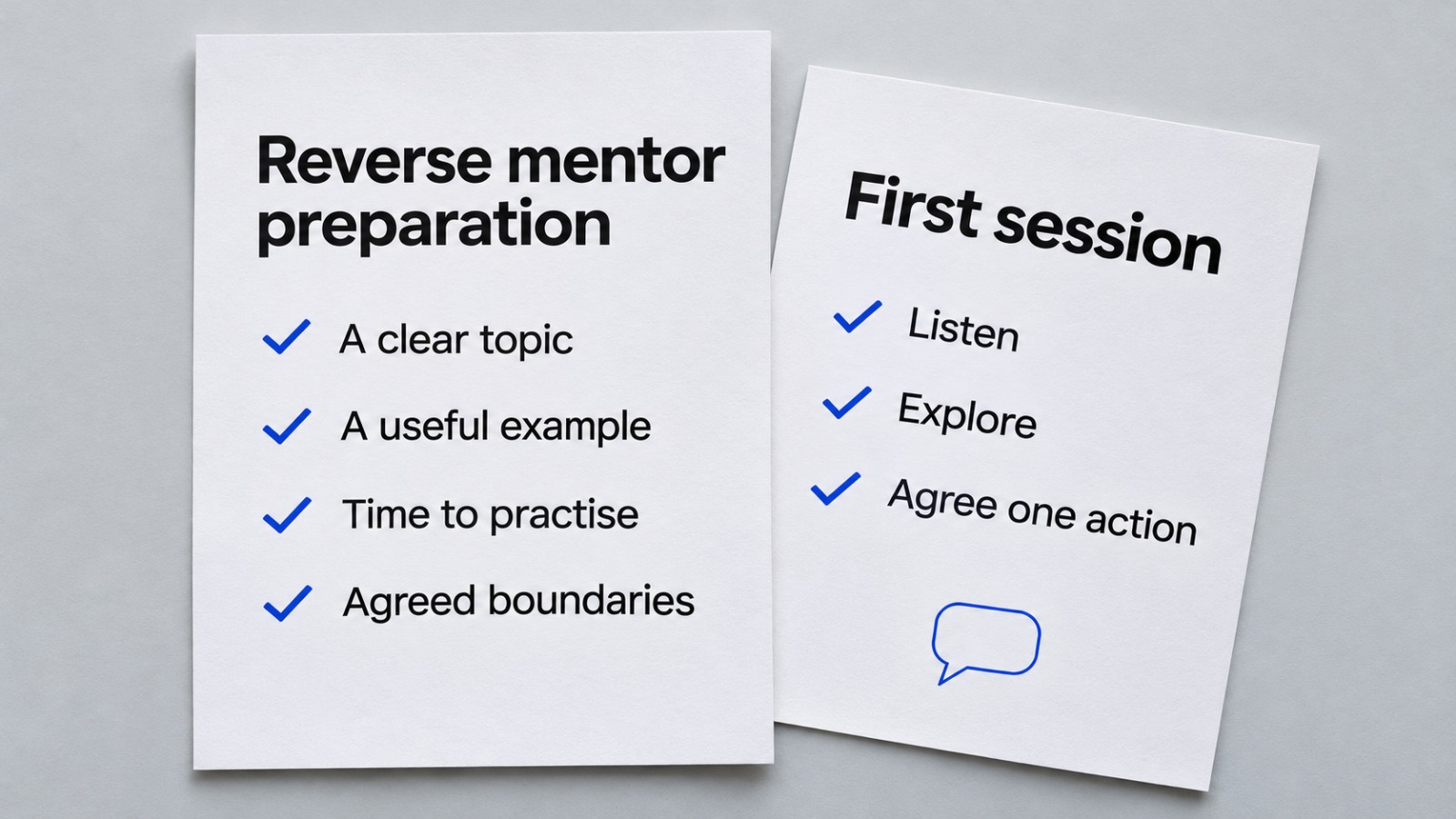
| Reverse mentoring | Learning from colleagues with different experiences or skills | Requires preparation around hierarchy, listening and trust |
Choose the format around the learning need and the participants' capacity to take part.
5. Match mentors and mentees thoughtfully
Useful matches begin with learning goals and relevant experience. Ask about skills, availability, communication preferences and potential conflicts of interest before proposing a pair.
For a UAE employer with teams in different locations, an online relationship may give an employee access to expertise beyond their own office. Check that working patterns and availability make the match practical.
Language preferences deserve attention too. Ask employees which language helps them discuss complex or sensitive topics comfortably. Do not infer that preference from nationality.
Explain why each match was proposed and allow participants to raise concerns privately. A simple rematching process can prevent an awkward pairing from becoming a silent withdrawal.
As participation grows, structured mentor matching can help programme teams organise goals, skills and preferences before reviewing proposed pairs.
6. Prepare mentors and mentees before the first session
A short preparation session can prevent avoidable confusion.
Mentors should understand how to listen, share experience without prescribing every answer, and help a mentee identify their own next step. Mentees should know that they are expected to bring questions, prepare an agenda and act on agreed commitments.
Both need clear boundaries.
Agree what remains private, what programme information HR receives and which concerns must follow the organisation's formal reporting procedures. Avoid promising absolute confidentiality.
A simple mentoring agreement should cover:
- Development goals.
- Meeting frequency and communication preferences.
- Preparation and follow-up.
- Privacy expectations and their limits.
- Cancellation arrangements.
- How to request support or a different match.
In a UAE programme, make it easy for participants to discuss preferences around communication, hierarchy and meeting arrangements without making assumptions about them.
7. Give each relationship a useful rhythm
Participants need enough structure to begin, with room to shape the relationship around their needs.
For the first meeting, suggest this agenda:
- Introduce your roles and relevant experience.
- Discuss what the mentee hopes to achieve.
- Agree one or two development goals.
- Set expectations about privacy and communication.
- Choose one action to complete before the next meeting.
- Book the next session.
Make goals observable.
“Become more confident” is difficult to review. “Lead the next project update meeting and ask two stakeholders for feedback” gives the mentee something concrete to practise.
| Stage | Focus | Practical output |
|---|---|---|
| First session | Goals and expectations | Mentoring agreement and one action |
| Early sessions | Current challenges and practical learning | An action to try at work after each conversation |
| Midpoint | Progress and relationship quality | Revised goals or support where needed |
| Final session | Learning and next steps | Development review and continuation plan |
Build the schedule around participants' actual calendars. Ask about shift patterns, travel, leave and availability during Ramadan. Agree a workable adjustment when needed.
8. Measure progress and improve the next cohort
Attendance tells you whether meetings happened. It does not tell you whether the conversations helped.
Use a small set of measures covering participation, relationship quality and learning.
| Measure | What it helps you understand |
|---|---|
| First-session completion | Whether pairs have started |
| Ongoing participation | Whether the agreed rhythm is sustainable |
| Match feedback | Whether participants can work productively together |
| Goal progress | Whether the relationship is moving towards its purpose |
| Examples of applied learning | What employees are doing differently |
| Programme support feedback | Where administration or guidance needs improvement |
Collect a baseline before the programme starts. At the midpoint and close, ask the same core questions so you can compare responses.
Useful questions include:
- Do you know what you want to achieve through mentoring?
- Can you discuss relevant challenges openly with your mentor?
- What have you applied at work?
- What is getting in the way?
- What support would make the next month more useful?
Longer-term measures, such as retention, internal moves or promotions, may also be relevant. Interpret them carefully. Mentoring participants may differ from other employees, and several factors influence career outcomes. Report the evidence without attributing every change to the programme.
A practical 90-day launch plan
The first 90 days can cover programme design, matching and the start of delivery. They do not need to contain the entire mentoring relationship.
| Timing | Main work | Deliverable |
|---|---|---|
| Days 1 to 15 | Define the purpose, audience, ownership and measures | Programme brief |
| Days 16 to 30 | Invite applications and explain expectations | Participant shortlist |
| Days 31 to 45 | Review profiles, propose matches and prepare participants | Confirmed pairs and mentoring agreements |
| Days 46 to 60 | Hold first sessions and agree goals | Individual development plans |
| Days 61 to 90 | Continue sessions, gather feedback and resolve barriers | Early progress review |
Leave space to fix problems. A pilot is useful because it reveals where the design needs adjustment.
Common mistakes that weaken a mentoring programme
Matching people and leaving them to figure everything out
Even experienced employees can struggle to begin. Provide a first-session agenda, example goals and a named contact.
Choosing mentors only because they are senior
Relevant experience matters, but so do listening, availability and the ability to help someone think. Give mentors preparation and an honest opportunity to decline if they cannot commit.
Collecting attendance without reviewing learning
A completed meeting is a useful operational measure. Pair it with goal progress and examples of what employees have applied at work.
Making mentoring feel like another performance review
Explain the mentor's role and what HR will see. Participants need clarity about where developmental conversations end and formal management processes begin.
Frequently asked questions about employee mentoring in the UAE
How long should an employee mentoring programme last?
A six-month pilot is a practical starting point for a focused development goal, with a midpoint review. This is a suggested design rather than a fixed standard. Adjust the duration to the learning need, meeting frequency and participants' availability.
Can mentoring support Emirati talent development?
Yes. An employer can design mentoring around individual career goals, professional networks, practical skills and leadership preparation. Define those outcomes clearly and assess progress. An internal mentoring programme should not be presented as proof that an employer has met Emiratisation requirements.
Should a mentor be the employee's line manager?
A line manager can provide valuable development support. For a formal mentoring programme, a mentor outside the reporting line can offer another perspective and space for career conversations. Choose the arrangement around the programme's purpose and any potential conflicts.
Can mentoring work across different UAE offices?
Yes. Online or blended sessions can connect employees across offices and departments. Check availability, provide a clear meeting rhythm and make sure both participants can speak privately.
How much does an employee mentoring programme cost?
The cost depends on participant time, programme administration, preparation, resources and any software or external support. Build the budget around the proposed cohort and delivery plan rather than assuming one standard cost per employee.
Do you need mentoring software for a pilot?
A small pilot can begin with simple tools if the programme owner can manage matching, reminders and reporting reliably. As participation grows, mentoring software can bring participant information, matching, guided journeys and programme reporting into one place.
Build a programme employees can use
Begin with a development need that employees recognise. Choose mentors who can help, protect time for conversations and give each pair a clear first step.
Then listen to the pilot cohort. Their experience will tell you whether the matching works, whether the goals are useful and what needs to change.
If you are planning an employee mentoring programme in the UAE, talk to Mentorgain about matching, participant journeys and reporting for your organisation.