.svg)
7 Meaningful Answers to "What Are Your Career Aspirations?" in an Interview

When an interviewer asks, "What are your career aspirations?", explain the work you want to grow into, the skills you want to develop, and how this role fits that direction. Add a real example that explains your interest. You do not need a fixed job title or a perfect five-year plan.
The question can still catch you off guard. Maybe you know exactly what you want. Maybe you are changing careers, applying for your first job, or simply looking for work you can do well without burning out.
You can give a thoughtful answer in any of those situations. The useful starting point is to describe what you want to become better at and why that matters to you.
Below are seven career aspirations examples you can adapt, followed by a simple way to build your own answer. These are illustrative scripts, not accounts from real candidates. Replace the details with experiences you can discuss honestly.
What are career aspirations?
Career aspirations are the longer-term direction you want your working life to take. They might involve becoming a specialist, leading a team, changing fields, doing more meaningful work, or building a stable career with increasing responsibility.
Career goals are the specific steps you take toward that direction. If your aspiration is to become a trusted data analyst, your next goal might be to improve your SQL skills and complete an analysis that helps a team make a decision.
An aspiration gives you a direction. A goal gives you something to do next. In an interview, connecting the two makes your answer more concrete.
Why do interviewers ask about your career aspirations?
Interviewers use this question to understand what motivates you and whether the role offers the kind of work you want to do. It also gives them a chance to see how you connect your development with a team's needs.
Harvard's Mignone Center for Career Success explains that employers assess candidates' reasons for applying, interest in the position, and potential contributions. Your answer should help them understand those connections.
For example, wanting to become an expert in customer research fits a role that involves interviewing customers and testing product ideas. It is harder to explain that fit if the job mostly involves scheduling social media posts.
Pay attention to that gap. An interview is also your chance to learn whether the work supports the career you actually want.
7 meaningful answers to "What are your career aspirations?"
Choose the example closest to your situation. You only need one clear direction for your answer, even if several of these appeal to you.
1. Build a strong foundation in your first professional role
Useful for: Freshers, recent graduates, and candidates with limited work experience.
"I'm looking to build a strong foundation in marketing, especially understanding why customers respond to one message and ignore another. During a college project, I enjoyed interviewing students and using their feedback to improve our event campaign. I'd like to develop that into a practical skill through real campaigns, feedback, and measurement. This role interests me because it includes both content work and campaign reporting. My first priority would be to become someone the team can rely on to deliver good work."
This answer gives an early-career candidate a credible direction without pretending to have everything mapped out. The project explains where the interest came from, and the final sentence shows a willingness to contribute.
Use a class assignment, internship, volunteer role, or part-time job as your evidence. Name what you did and what it taught you about the work you enjoy.
2. Become a specialist people trust with difficult problems
Useful for: Analysts, engineers, designers, finance professionals, and other people who want to deepen their expertise.
"I'd like to become the person a team turns to when a reporting problem is difficult to untangle. I enjoy tracing a number back to its source and working out why different reports disagree. In my current role, I've started documenting those issues so we don't repeat the same checks each month. My next step is to build stronger data modelling skills and take responsibility for more complex reporting. The focus on data quality in this role is what caught my attention."
A specialist path is a meaningful career aspiration. You do not need to say you want to manage people to sound ambitious.
The detail about documenting recurring problems makes this answer believable. Replace it with a genuine example of how you already approach your chosen area, then name the next level of work you want to handle.
3. Grow into a thoughtful people manager
Useful for: Experienced individual contributors who want to move into people leadership.
"Over time, I'd like to manage a team. I've enjoyed helping new colleagues get comfortable with our work, and it's made me interested in the development side of management. I also know that helping someone informally is different from being responsible for their workload, feedback, and performance. I'd like to build those skills while continuing to deliver in my own role. The chance to mentor junior colleagues here appeals to me, and I'd want to understand how people prepare for management responsibilities."
This answer shows interest in the actual work of management, including its harder parts. It also leaves room for a realistic conversation about opportunities.
Only mention mentoring or a leadership path if the employer has described it. Otherwise, make it a question. Avoid assuming that joining the company comes with a promised promotion.
4. Take ownership of projects from start to finish
Useful for: Coordinators and professionals ready for broader responsibility across teams.
"I want to become better at taking a project from a loose brief to a finished result. I've handled scheduling and follow-ups on several launches, and I found that I enjoyed spotting dependencies and getting people aligned before a deadline became a problem. My next step is to own a small project, including the plan, trade-offs, and review afterwards. This position appeals to me because it involves coordinating work across operations and sales, which is the kind of responsibility I want to develop."
This is a useful option when you want more responsibility but are not aiming to become a people manager. It describes progress through the scope of your work.
Be precise about your past contribution. If you supported a launch, say that. Claiming you led it could create an awkward follow-up when the interviewer asks what you were accountable for.
5. Make a deliberate career change
Useful for: Candidates moving into a new function or industry.
"My aspiration is to move from customer support into customer success, where I can help customers get value from a product over time. Support has taught me to ask good questions, explain things clearly, and stay calm when someone is frustrated. I've also started looking for patterns in the issues customers raise, rather than treating every ticket separately. I want to build on that experience by learning account planning and proactive onboarding. This role looks like a practical next step because it combines product guidance with ongoing customer relationships."
The connection between past experience and future work matters more than an elaborate explanation of why you want to leave your current field.
Show what transfers, what you still need to learn, and what you have done to explore the move. A course can support your answer, but a relevant project or conversation with someone in the field can help you explain your decision more clearly.
6. Make a measurable difference to customers or users
Useful for: Candidates motivated by service quality, useful products, or solving a particular problem.
"I want to build a career around making complicated services easier for people to use. In my last role, I noticed how often customers needed help with the same application steps, and I worked with a colleague to make the instructions clearer. I'd like to develop stronger research and service-design skills so I can address those problems earlier. Your focus on improving the onboarding experience interests me because it's a concrete area where I could contribute while developing that expertise."
Saying you want to "make an impact" leaves the interviewer with a lot to guess. Naming a problem and the people affected makes the aspiration easier to understand.
If you have a real result, include it. If you did not measure the outcome, explain the change you made without inventing a percentage or claiming credit for work you did not do.
7. Build a dependable career while exploring your longer-term direction
Useful for: Candidates who know the work they enjoy but have not chosen a final career path.
"I haven't settled on a specific title I'd like to hold five years from now. What I do know is that I enjoy organising work, solving practical problems, and becoming someone colleagues can count on. In my next role, I want to get stronger at planning and improve how I use data to make everyday decisions. This operations role offers both. As I gain experience, I'd like to see whether my strengths lead me toward process improvement or team leadership."
You can be honest about uncertainty while showing that you have thought about your next step. This answer gives the interviewer a clear picture of your interests and immediate priorities.
A dependable career is a legitimate aspiration. Focus on the kind of work you want to sustain, the capabilities you want to build, and the contribution you want to make.
How to build your own career aspirations answer
A useful structure is direction, evidence, next step, and fit. Treat it as a way to organise your thoughts, not a script you must recite.
- Direction: Name the work or responsibility you want to grow into. Choose something you actually find interesting.
- Evidence: Describe one experience that helps explain your choice. Keep it short enough that the answer stays focused on your future.
- Next step: Identify a skill, project, or responsibility you want to develop next.
- Fit: Connect that next step to something specific in the job description or your conversation with the employer.
Here is a template you can adapt:
"I'd like to grow into [type of work or responsibility]. I've found that I enjoy [specific activity], particularly when [brief real example]. My next step is to develop [skill or experience]. This role interests me because [verified responsibility or opportunity], and I'd like to contribute by [relevant outcome]."
As a practical rehearsal target, try explaining your answer in about a minute. There is no required length. Give the interviewer enough detail to understand your direction, then leave room for a follow-up.
Read the answer aloud. Remove any phrase you would never use in conversation. "I want to get better at explaining technical decisions" will often sound more convincing than "I aspire to drive strategic cross-functional alignment."
Harvard's interview preparation guidance makes a useful distinction: practice helps you clarify and communicate your thoughts; it does not mean memorising answers.
What if you do not know your career aspirations yet?
Start with what you have noticed about your work so far. You may not know your destination, but you can often identify the tasks you enjoy, the problems you care about, and the skills you want to use more often.
Write a few notes in response to these questions:
- When have I felt most useful at work, in education, or while volunteering?
- What do people already ask me to help with?
- Which tasks would I like to spend more time doing?
- What would I like to handle with more confidence a year from now?
If you need a broader starting point, try the O*NET Interest Profiler to explore your work interests. Use the results as prompts for reflection, then compare them with real job responsibilities.
A mentor can also help you examine the choices behind an aspiration. Ask what a typical week in the role looks like, which responsibilities are hardest, and what experience would help you test your interest.
Mentorgain's career development goals for mentees offers examples for turning a broad direction into a practical next step. If you have someone in mind but are unsure how to approach them, use this guide on how to ask someone to be your mentor.
What should you avoid saying?
The problem with a weak answer is often that it leaves too much unexplained. Watch for these common traps:
- "I want to be successful." Explain what success means in the work: expertise, responsibility, service, stability, or something else.
- "I want your job." Describe the leadership responsibilities that interest you instead of turning the answer into a challenge.
- "I'll do whatever the company needs." Show flexibility, but give the interviewer some sense of your own interests and strengths.
- "I expect to be promoted within a year." Talk about the capability you want to build before assuming a timeline or vacancy.
- "I just need to get out of my current job." Explain what you are moving toward. A difficult experience does not have to define your next step.
Better pay, reasonable hours, and stability are valid priorities. You can discuss them when assessing the role. For this question, also explain the work you want to do and why it suits you. You do not need to invent a passion or promise a lifetime at the company.
Questions to ask after discussing your career aspirations
Your answer can open a useful conversation about what growth would actually look like. Choose one or two questions that matter to you:
- What would someone in this role be expected to handle independently after the first year?
- How do people here develop deeper expertise or prepare for management?
- Could you share an example of how someone's responsibilities have grown on this team?
- What feedback or mentoring would be available as I learn the role?
Listen for specific examples. They give you more to work with than a general promise that there is plenty of room to grow.
How Mentorgain helps turn career aspirations into action
An interview gives you a reason to put your career aspirations into words. Mentoring gives you space to explore what those aspirations would mean in practice, including the parts of a role you have not experienced yet.
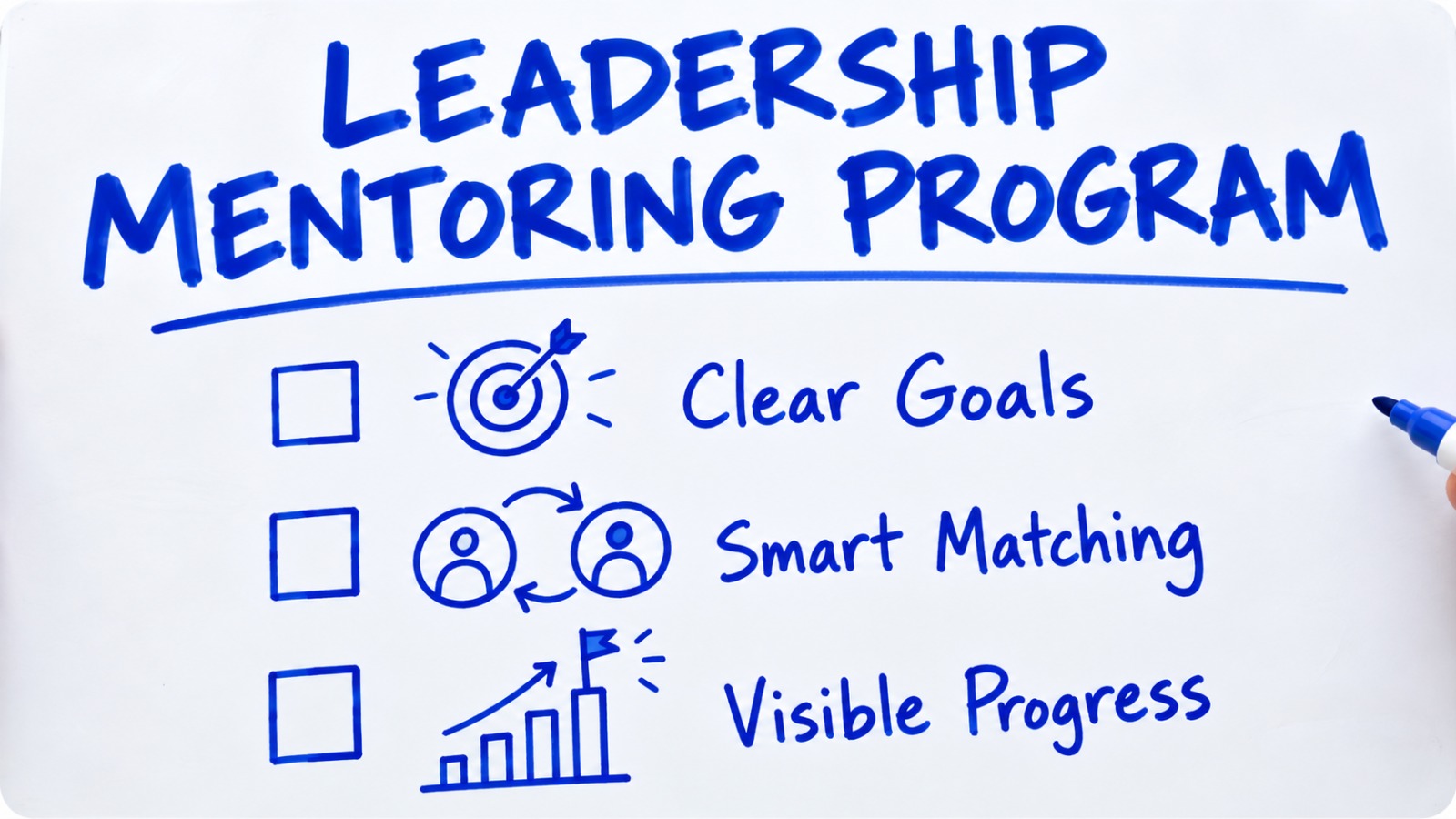
Mentorgain's mentoring software helps organisations run structured mentoring programmes that support these conversations. For employees participating in a programme, that structure can help in three ways:
- Find relevant guidance. Matching can consider goals, skills, experience, and preferences, helping programme teams connect employees with mentors whose experience relates to the direction they want to explore.
- Turn an ambition into a next step. Guided journeys connect mentoring sessions with goals, notes, and tasks, giving each conversation a practical follow-up.
- Keep track of development. Goal progress and session records give participants something concrete to revisit as they reflect on what they have learned and where they need more support.
For example, someone considering management could use a mentoring conversation to understand how an experienced manager handles difficult feedback. They might then agree on a small development goal, practise it in an appropriate setting, and discuss what happened at their next session. That experience gives them more to draw on when explaining why leadership interests them.
If your organisation offers a mentoring programme, bring one career aspiration to your next session and ask what you could do to test it. For HR and learning teams looking to provide that support, explore how Mentorgain structures mentoring programmes.
Frequently asked questions about career aspirations
What is a good career aspiration to say in an interview?
A good career aspiration is honest, relevant to the role, and specific enough to discuss. You might want to become a specialist, manage a team, own projects, or solve a particular customer problem. Explain why that direction interests you and what you want to learn next.
How should freshers answer "What are your career aspirations?"
Freshers can describe the foundation they want to build, one skill they are keen to develop, and a project or experience that sparked their interest. Connect those points to the job. You do not need to claim leadership ambitions or predict your entire career.
Are career aspirations the same as career goals?
Career aspirations describe a broader direction, such as becoming a respected designer. Career goals describe specific steps toward it, such as improving user research skills or taking ownership of a design project. An interview answer becomes clearer when it includes both.
Can I say I do not want to become a manager?
Yes. You can explain that you want to build deeper expertise, solve more complex problems, or take responsibility for larger pieces of work. If you are applying for a management position, discuss that mismatch honestly rather than presenting ambitions you do not have.
How is this different from "Where do you see yourself in five years?"
The questions overlap, but a five-year question adds a time horizon. Describe the skills, scope, or responsibilities you hope to have developed by then. You can name a possible role without treating a particular title or promotion as guaranteed.
Choose an answer you can explain in your own words
Before your next interview, write down three things: the work you want more of, an experience that explains why, and one reason this role could help you move in that direction.
Then practise saying it without reading. If the interviewer asks, "What made you interested in that?", you should have something real to say.
And if preparing the answer reveals that the job does not fit your aspirations, that is useful information too. The question can help you make a better career decision as well as give a better interview answer.




.webp)