.svg)
Reverse Mentoring: Why India's Top Companies Are Flipping the Mentorship Model
October 2, 2026
Gauri Gokhale
There is a moment many Indian CHROs know well. A senior leader- twenty-five years of experience, a corner office, a track record of results, sits in a digital transformation workshop looking quietly lost. The facilitator is talking about AI tools, short-form video strategy, or asynchronous collaboration. The leader nods. But they are not keeping up.
Now imagine that same leader, six months later, having weekly conversations with a 26-year-old analyst from their own organisation who grew up on these tools, thinks natively in them, and when given the right structure and psychological safety can teach fluently.
That is reverse mentoring. And it is one of the most underutilised levers in Indian corporate talent development.
This guide explains what reverse mentoring is, why it is particularly valuable and particularly challenging in the Indian workplace, and how to run a programme that actually works rather than one that dies in the second month when senior leaders quietly stop showing up.
What Is Reverse Mentoring?
In traditional mentoring, a senior or more experienced employee guides a junior colleague sharing career wisdom, organisational knowledge, and professional development support. Reverse mentoring flips this dynamic. A junior employee acts as the mentor, and the senior leader becomes the mentee.
The concept was popularised in 1999 by Jack Welch, then CEO of General Electric, who paired 500 senior executives with younger employees to develop their digital literacy. What began as a technology catch-up exercise has evolved into something far more valuable: a structured mechanism for cross-generational learning, DEI advancement, and cultural intelligence inside organisations.
Today, companies like KPMG, PwC, Cisco, Heineken, and Linklaters run formal reverse mentoring programmes. In India, a small number of large enterprises have piloted them but adoption remains far behind what the opportunity warrants.
Why Reverse Mentoring Matters More in India Right Now
Three forces are converging to make reverse mentoring especially relevant for Indian organisations in 2025:
1. The AI literacy gap is real and growing
India's workforce spans five generations, and the gap in digital fluency between Gen Z employees and senior leadership is widening faster than most organisations acknowledge. Forty-four percent of current skills will be disrupted by technology within five years, according to Mercer's 2024–25 Skills Snapshot Report. Senior leaders who are not fluent in AI tools, digital collaboration platforms, and data-driven decision-making are already operating at a disadvantage and the gap compounds every quarter.
Reverse mentoring is the most efficient way to close this gap. A structured programme where a 24-year-old data analyst teaches a Vice President how to use AI summarisation tools, interpret dashboards, or navigate emerging platforms is faster and more contextually relevant than any training course. Mentorgain's Continuous Learning & Cross-Functional Development use case is built precisely for this kind of structured skills transfer.
2. Gen Z is India's largest workforce cohort and they are leaving
India added more Gen Z workers to its corporate workforce than any other country over the past three years. This cohort brings exceptional digital fluency, fresh consumer and market perspectives, and a strong appetite for meaningful work. They also leave at alarming rates when they feel unheard or undervalued.
Reverse mentoring directly addresses this. When a junior employee is given genuine responsibility to teach a senior leader, the message sent to that employee and to their cohort watching is unambiguous: your knowledge matters here. Studies consistently show that employees who participate in reverse mentoring as mentors report higher engagement, stronger loyalty, and greater confidence in pursuing leadership roles. For organisations focused on employee retention and engagement, reverse mentoring is one of the most cost-effective interventions available.
3. Indian workplaces are grappling with inclusion and traditional approaches are not enough
DEI commitments in Indian organisations are increasingly visible, but genuine behavioural change at leadership level remains slow. Reverse mentoring creates structured, repeated exposure between senior leaders and employees from different backgrounds -women, employees from Tier 2 and Tier 3 cities, younger workforce members - in a context where the junior person holds expertise authority. This repeated dynamic, done consistently, shifts the unconscious patterns that traditional training rarely touches. Mentorgain's Diversity, Inclusion & Belonging programme framework is designed to support exactly this kind of structured cross-demographic connection.
The Honest Challenge: Why Hierarchy Makes This Hard in India
This is the part most reverse mentoring guides skip over, and it is the reason so many programmes in Indian organisations fail within weeks.
Indian corporate culture is built on deep respect for seniority. The idea of a 25-year-old correcting a General Manager even gently, even in a skills context runs against decades of internalised workplace norms for both parties. Junior employees fear being perceived as arrogant. Senior leaders, even when genuinely interested, struggle to adopt a learning posture in front of someone they outrank.
The programmes that work in India address this directly. They do not pretend the hierarchy does not exist. Instead, they reframe the dynamic in a way that makes it psychologically safe for both parties.
The reframe that works: This is not about the junior employee knowing more than the senior leader. It is about the junior employee having a different, specific kind of knowledge that the senior leader has not had the opportunity to develop. Framing it as a skills-transfer in a defined domain - not a general knowledge transfer, removes the status threat.
Organisations that have run successful reverse mentoring programmes in India consistently report two non-negotiables: senior leadership must visibly champion the programme (not just approve it), and junior mentors must receive preparation and coaching before their first session. Sending an unprepared 26-year-old into a room with a Vice President and hoping for the best is a recipe for a stilted, surface-level conversation that neither party wants to repeat.
What Topics Work Best for Reverse Mentoring in India
The most successful reverse mentoring programmes focus on a defined skills domain rather than asking junior employees to mentor broadly. The topics that produce the best results in Indian organisations currently are:
- AI tools and workflows - using generative AI for productivity, summarisation, drafting, and analysis
- Digital marketing and social media - how younger consumers discover, evaluate, and engage with brands
- Data literacy - how to read dashboards, interpret basic analytics, and ask better questions of data teams
- Gen Z workplace expectations - what the incoming workforce actually wants, how they communicate, and what makes them stay
- Sustainability and ESG fluency - younger employees often carry more sophisticated views on environmental and social issues than their senior counterparts
- Diversity and inclusion lived experience - giving underrepresented employees structured access to leadership conversations
Programmes that try to make reverse mentoring a general 'career conversation' or 'cultural exchange' without a defined learning focus tend to run out of content within three sessions. Define the domain first.
How to Structure a Reverse Mentoring Programme: Step by Step
Step 1: Define the learning objective
What specific capability do you want senior leaders to develop? Be precise. 'Better understanding of digital' is too vague. 'Ability to use AI tools for daily productivity tasks' is a learning objective you can design a programme around.
Step 2: Select and prepare junior mentors carefully
Not every junior employee is suited to mentor a senior leader. Look for employees who are genuinely expert in the target domain, have good communication skills, and critically have the confidence and emotional intelligence to hold their position in a session without being either deferential or combative. Invest in a half-day mentor preparation session before launch. Cover: how to structure a session, how to handle pushback, how to teach without lecturing, and how to navigate the power dynamic with grace.
Step 3: Set clear expectations with senior mentees
Senior leaders need to understand what they are signing up for before the first session. The commitment is: one hour per month for six months, genuine curiosity and openness, and a willingness to be a beginner in the room. Leaders who are coerced into the programme make poor mentees. The best programmes make participation voluntary but make the business case compelling enough that leaders want to join. Mentorgain's resources for HR Leaders include guidance on building exactly this kind of internal case.
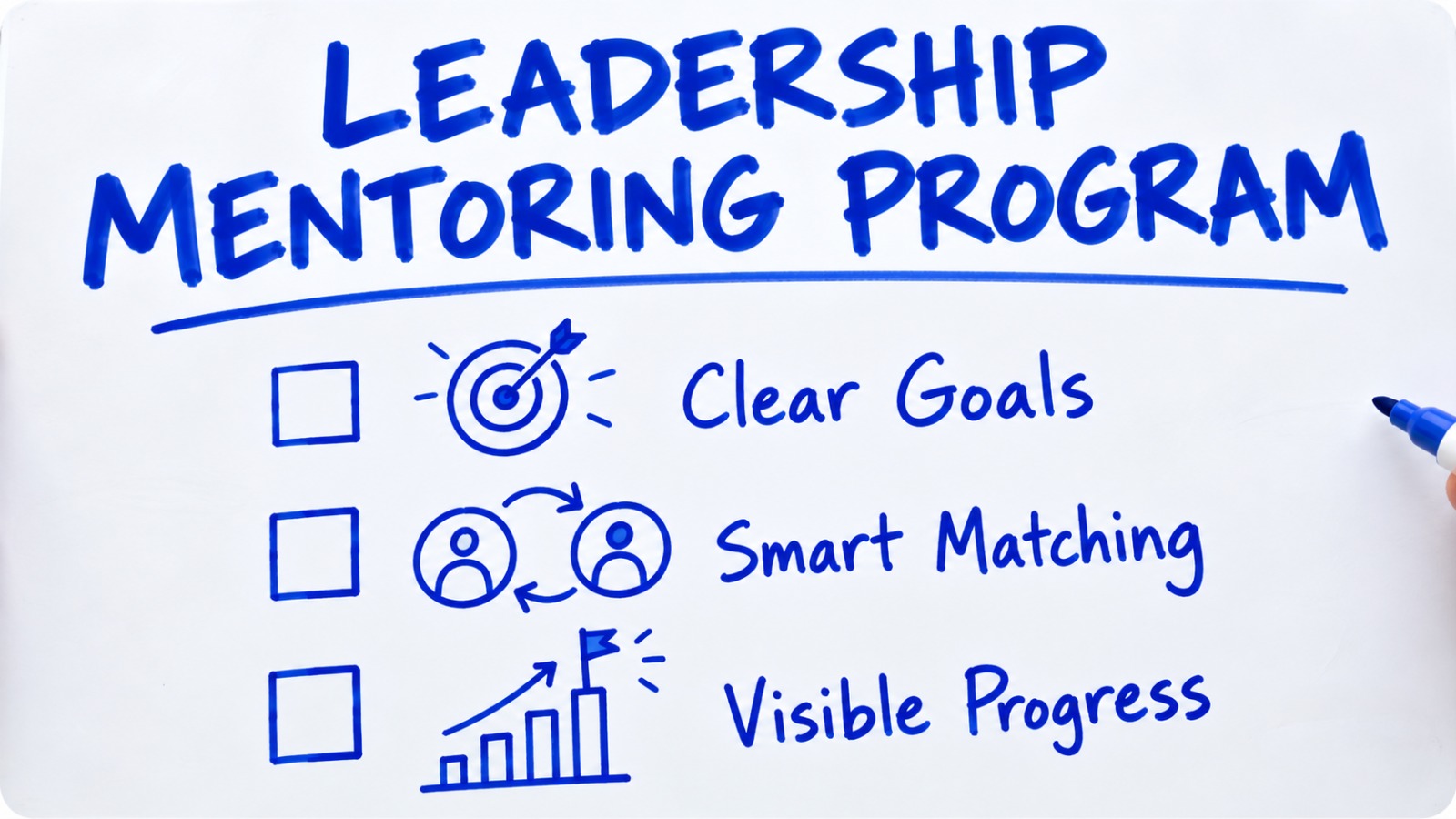
Step 4: Match with intention
Match based on the learning objective and on relationship compatibility, not just availability. A junior employee in the marketing team is probably not the best match for the CFO who wants to develop AI literacy in financial analysis. Cross-functional matches work well when the domain is clearly defined and shared; they create confusion when the domain is vague. Mentorgain's smart matching feature aligns skills, goals, and experience to create pairings that actually hold.
Step 5: Provide session frameworks
Give every pair a structured agenda for their first three sessions. The first session should be almost entirely about establishing rapport, setting shared expectations, and identifying the specific skills the senior mentee wants to develop. Pairs that skip this and try to dive straight into content in the first session often find the relationship awkward by session three.
Step 6: Create psychological safety from the top
The most powerful thing a senior leader can do to make a reverse mentoring programme succeed is to publicly share something they learned from their junior mentor. When a Managing Director tells their leadership team, 'My reverse mentor showed me how to use AI to summarise board documents — it saves me two hours a week,' every other senior leader in the programme relaxes. Vulnerability from the top is the single most effective tool for making the dynamic work.
Step 7: Measure and celebrate
Track session completion rates, skill acquisition (through brief before-and-after self-assessments), and participant satisfaction. At the six-month mark, run a structured review. Celebrate specific outcomes publicly - the senior leader who now runs their own data dashboard, the junior mentor who presented to the board based on what they taught their mentee. Stories travel further than data in driving programme adoption.
What Good Reverse Mentoring Looks Like in Practice
Example: A senior HR leader at a large Indian BFSI company is paired with a 27-year-old data analyst for a six-month AI literacy programme. In their first session, the analyst asks the leader to describe their three most time-consuming weekly tasks. By session two, they are working through how AI tools can automate two of them. By session four, the leader is independently prompting an AI assistant to draft policy summaries. By session six, the leader has become an internal advocate for AI adoption - not because of a training course, but because they learned it hands-on in a low-stakes, trusting relationship.
This is the compound effect of reverse mentoring done well. It does not just transfer skills — it transfers curiosity, changes how senior leaders think about the employees below them, and creates a junior mentor who has had a genuinely career-defining experience.
Reverse Mentoring vs Traditional Mentoring: Do You Need Both?
YYes — and they serve different purposes. Traditional mentoring develops junior employees' careers, builds leadership pipelines, and transfers organisational wisdom. Reverse mentoring develops senior leaders' current capabilities, builds cross-generational understanding, and gives junior employees visibility and voice at leadership level.
The most effective talent development strategies run both simultaneously. Traditional mentoring flows downward through the hierarchy; reverse mentoring flows upward. Together, they create a culture of continuous learning at every level.
For Indian organisations building a mentoring strategy for the first time, the practical recommendation is to start with traditional mentoring - it is more intuitive to implement and produces faster visible results. Once that programme is established, introduce reverse mentoring as a parallel stream, ideally targeting a specific cohort of senior leaders around a well-defined learning objective.
Using a Platform vs Managing Manually
Small reverse mentoring pilots of 5-8 pairs can be managed with spreadsheets, calendar invites, and a shared session guide document. Above that threshold, the coordination overhead becomes significant and matching quality drops.
A mentoring platform automates matching, sends session reminders, provides conversation frameworks, tracks completion rates, and gives programme managers real-time visibility into which pairs are engaging and which are stalling. For a reverse mentoring programme running across multiple business units or cities, the difference between a platform and a spreadsheet is the difference between a programme that scales and one that quietly collapses after the pilot.
Mentorgain's mentoring software supports supports reverse mentoring as a programme format alongside traditional 1:1 and group mentoring - with matching algorithms, session frameworks, and dashboards designed for the Indian workplace context.
Want to pilot a reverse mentoring programme at your organisation? Mentorgain makes it easy to set up, match, and manage - with India-specific support. → Book a Free Demo at mentorgain.com
Frequently Asked Questions
What is reverse mentoring?
Reverse mentoring is a formal programme where junior or less experienced employees mentor senior colleagues, typically to share knowledge in areas like digital skills, technology, emerging trends, and DEI perspectives. It flips the traditional mentoring dynamic where wisdom flows downward through the hierarchy.
What are the benefits of reverse mentoring?
Key benefits include closing digital and AI skills gaps in senior leadership, improving cross-generational understanding, increasing engagement and retention of junior employees, advancing DEI by giving underrepresented employees voice at leadership level, and building a more innovative and inclusive culture.
Why is reverse mentoring challenging in Indian workplaces?
Indian corporate culture's deep respect for seniority can make it psychologically uncomfortable for junior employees to teach senior leaders, and for senior leaders to adopt a learning posture in front of someone they outrank. Successful programmes address this directly through careful framing, mentor preparation, and visible senior-leader advocacy.
How long should a reverse mentoring programme run?
Six months with monthly one-hour sessions is the most effective structure for a first programme. This is enough time to develop genuine skills and relationship depth without becoming an open-ended commitment that participants struggle to sustain.
How is reverse mentoring different from peer mentoring?
Peer mentoring pairs employees at similar career levels or experience stages to support each other's development. Reverse mentoring specifically pairs a junior employee as the mentor with a senior colleague as the mentee, with the explicit purpose of transferring knowledge that flows more naturally from junior to senior — particularly digital skills, generational perspectives, and emerging trends.




.webp)