White-Label Mentoring Software RFP Template and Questions for Vendors
November 5, 2026
Gauri Gokhale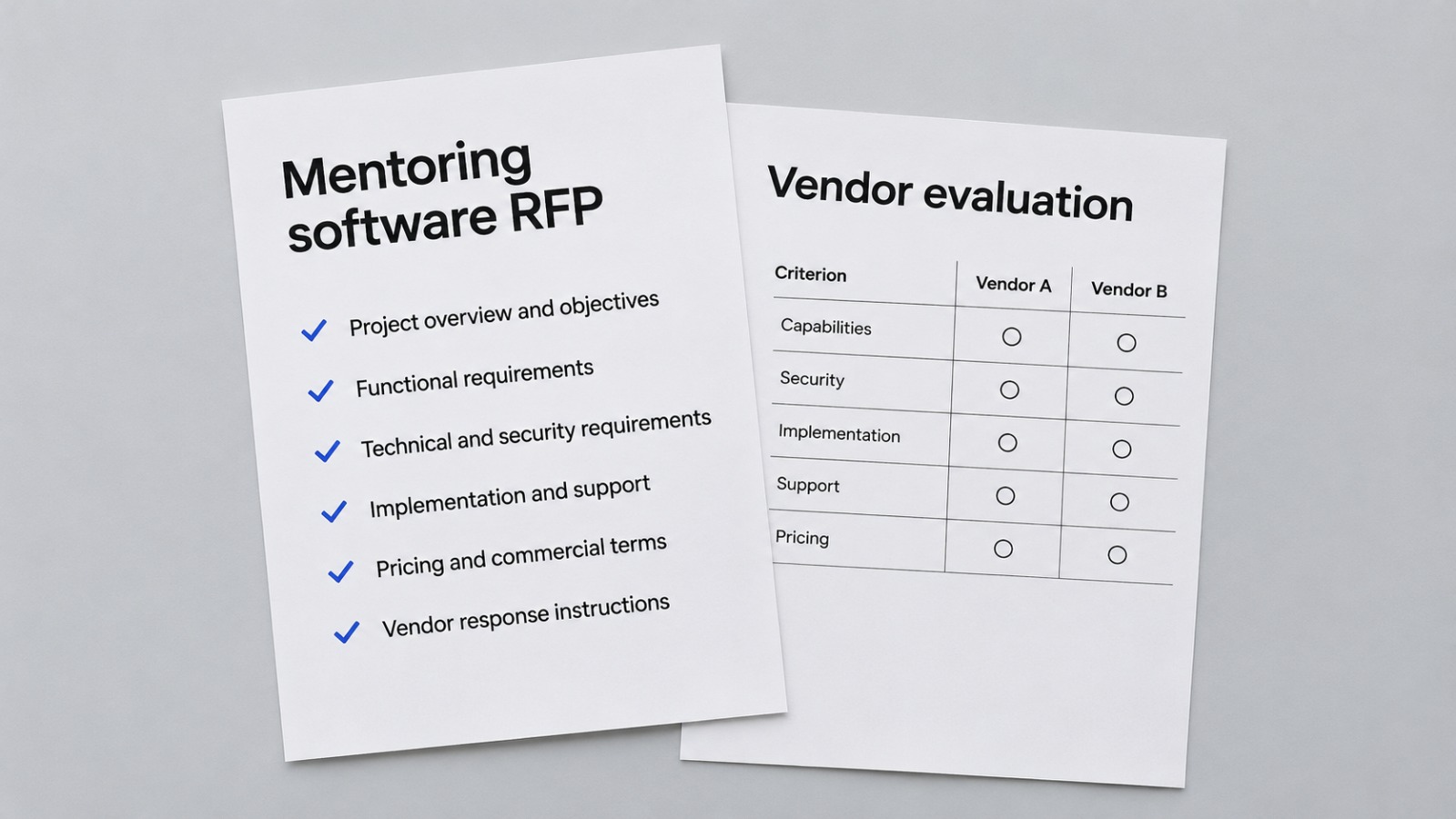
A white-label mentoring software RFP should define your program goals, specify exactly what must carry your brand, and ask vendors to prove how matching, privacy, integrations, reporting and support work. Require evidence, a complete price breakdown and an exit plan before you compare proposals.
A polished demo can make several platforms look equally capable. The differences tend to show up later: a reminder email carries the wrong brand, a departing employee keeps access, or an administrator cannot export the data needed for a quarterly review. A good request for proposal brings those details into the buying conversation early.
Use the template below to give every vendor the same brief. The separate editable download includes response fields, a scorecard and a final selection checklist, so your HR, learning and development, IT and procurement teams can work from one document.
What is white-label mentoring software
White-label mentoring software is a mentoring platform that an organization can present under its own brand. Depending on the vendor and contract, that may include logos, colors, a custom domain, email communications and program terminology. The underlying software is still supplied and maintained by the vendor.
The term does not tell you how far customization goes. A branded landing page is different from a fully branded participant journey. It also does not establish whether separate clients have isolated data, whether you can resell access, or whether a branded mobile app is included. Ask about each requirement separately.
When to use an RFP
Use an RFP when several teams need to agree on requirements, you are comparing multiple vendors, or your rollout involves sensitive data, integrations or multiple brands. For a small pilot, a shorter requirements brief and a structured demonstration may be enough. The aim is to make the decision clearer, not to create paperwork for its own sake.
Before approaching vendors, agree on the participant groups, program owner, expected enrollment, mentoring format and first-cohort launch date. Decide which requirements are essential. A missing mandatory identity control should not disappear inside a strong average score.
Copy this white-label mentoring software RFP template
Replace the bracketed fields, remove requirements you do not need and send the same version to every vendor. Label each requirement Must, Should or Could. Invite vendors to identify assumptions rather than quietly price around them.
| RFP section | Information to include |
|---|---|
| Organization and purpose | [Organization], [program owner], [business problem], [audience] and [desired outcomes]. |
| Program scope | [Eligible participants], [expected active users], [countries], [languages], [mentoring formats] and [number of brands or workspaces]. |
| Mandatory requirements | [Branding surfaces], [identity controls], [data boundaries], [required integrations], [accessibility needs] and [reporting requirements]. |
| Delivery and responsibilities | [Target launch], [migration scope], [internal owners], [training], [support hours] and [acceptance criteria]. |
| Commercial assumptions | [Contract term], [usage forecast], [budget range if shared], [currency] and requested three-year pricing. |
| Procurement process | [Questions deadline], [response deadline and timezone], [submission contact], [demo dates] and [decision date]. |
Suggested vendor response instruction: For each requirement, state Available now, Configuration required, Custom development, Planned or Not supported. Specify the relevant plan, additional cost, implementation effort, dependencies and evidence. For planned work, provide the target date and say whether delivery will be a contractual commitment. Do not mark roadmap features as available.
Request separate attachments for pricing, implementation, security evidence, accessibility information, service levels and proposed contract terms. Keep the main response tied to requirement IDs so reviewers can compare answers without searching through sales decks.
20 questions to ask mentoring software vendors
Ask vendors to demonstrate the workflows that matter to your program. A yes-or-no answer can confirm that a feature exists while leaving its limits completely unclear.
Branding and the participant experience
1. Which screens and communications can carry our brand, and where will yours remain visible?
Evidence to request: A live walkthrough of sign-in, invitations, reminders, booking, password resets, help pages and mobile views. Include logos, colors, terminology and any limitations.
2. Can we use our own domain and email sender identity?
Evidence to request: Describe domain setup, sender authentication, reply handling, certificate management and who owns maintenance. List setup and recurring charges.
3. Can different programs or client organizations have separate branding?
Evidence to request: Show the branding hierarchy and permission boundaries. Clarify whether separate brands require separate contracts or workspaces.
Matching and program operations
4. How can we configure and review mentor recommendations?
Evidence to request: Demonstrate goals, skills, availability, capacity, exclusions and administrator overrides using sample profiles. Explain what happens when nobody is a suitable match.
5. Can participants choose mentors, accept a pairing and request a rematch?
Evidence to request: Show the complete workflow, including consent, approval rules, notifications and the history retained after a rematch.
6. Which mentoring formats and program journeys are supported today?
Evidence to request: Demonstrate the formats you need, such as one-to-one, group or reverse mentoring. Show milestones, resources, reminders and cohort management.
7. What work remains with our program team?
Evidence to request: List routine tasks, bulk actions, escalation routes and training requirements. Demonstrate how an administrator follows up with inactive pairs.
For examples of the decisions to test, review how Mentorgain approaches mentor matching, including participant exploration, assigned pairing and configurable priorities.
Security and privacy
8. Who can see profiles, meeting notes, survey responses and development goals?
Evidence to request: Provide a role-by-role access matrix. Separate participant notes from administrative reporting and show how permissions are enforced.
9. Where is our data stored and who else processes it?
Evidence to request: Identify primary and backup locations, subprocessors, retention settings and deletion procedures. Provide the proposed data processing agreement for review.
10. What independent security evidence can we review?
Evidence to request: Provide relevant current assurance reports or certificates, their scope and dates, plus a summary of penetration-test findings and remediation. Explain any exclusions.
11. How are incidents, outages and recovery handled?
Evidence to request: Describe notification commitments, escalation contacts, backup testing, recovery time and recovery point objectives. Provide the proposed service level agreement.
NIST published the Cybersecurity Framework 2.0 on February 26, 2024. Its high-level risk outcomes can help structure your security conversation. They do not replace a review of the vendor's actual controls and evidence.
Integrations and flexibility
12. Which integrations are included and how do they work?
Evidence to request: Separate native integrations, API connections, middleware and manual imports. Show the actual identity, HR system, calendar or collaboration workflow you need.
13. What happens when an employee joins, changes roles or leaves?
Evidence to request: Demonstrate provisioning, attribute updates and deprovisioning. Explain single sign-on, account recovery, API limits and failed-sync alerts.
14. Can we add integrations midway through the program?
Evidence to request: Explain whether integrations can be added after launch, including supported systems, setup time, additional costs and technical dependencies. Describe any downtime, data migration or changes to existing workflows, and who handles implementation and testing.
Reporting and responsible use of AI
15. How are program metrics calculated and exported?
Evidence to request: Show definitions, denominators, time windows, filters and a sample export. Distinguish enrollment, active pairs, completed sessions, goal progress and feedback.
16. Can reporting protect small groups and sensitive responses?
Evidence to request: Show access restrictions, aggregation rules and how administrators avoid identifying individuals through filters or exports.
17. Where does the product use AI and what data does it receive?
Evidence to request: List models or providers, purposes, retention, training use, opt-out settings and human review controls. Explain whether disabling AI changes core workflows.
Define success before reviewing dashboards. Mentorgain's reporting and surveys overview is a useful starting point for discussing feedback and progress. A completed session shows activity; it does not, by itself, prove a change in retention or performance.
Implementation and commercial terms
18. What must happen before launch and who owns each step?
Evidence to request: Provide a project plan with dependencies, named responsibilities, migration scope, acceptance criteria, training and support coverage.
19. What will we pay over three years at our expected usage?
Evidence to request: Itemize licenses, branding, domains, integrations, migration, support, storage, overages, taxes and renewal increases. Define exactly what counts as a billable user.
20. How do we leave and recover our data?
Evidence to request: Provide export formats, included records, transition support, fees, delivery deadlines and deletion confirmation. Explain what is excluded and how backups expire.
How to score vendor responses fairly
Start with mandatory requirements as pass-or-fail gates. Then score the vendors that pass. The weights below are a suggested starting point, not an industry benchmark. Adjust them before proposals arrive, especially if your program has unusual security or branding needs.
| Evaluation category | Suggested weight |
|---|---|
| Branding and participant experience | 15% |
| Matching and program operations | 25% |
| Security and privacy | 20% |
| Integrations and flexibility | 15% |
| Reporting and AI controls | 10% |
| Implementation and commercial terms | 15% |
Use a 0 to 5 scale: 0 means unsupported; 1 means a major gap or an uncommitted roadmap item; 2 means a partial fit with substantial work; 3 means it meets the requirement with evidence; 4 means it meets it well with minor limitations; and 5 means a strong fit proven in your agreed scenario. Score requirements individually, then average within each category.
Weighted points = category score ÷ 5 × category weight. A score of 4 in a category weighted at 25% earns 20 points out of 100. Record the evidence and the reason for each score. Keep commercial assumptions consistent across vendors, including the number of billable users and which services are included.
Run a demo that follows one complete mentoring journey
Send shortlisted vendors the same scenario: a mentee joins a branded leadership program, reviews potential mentors, accepts a match, schedules a meeting and completes a check-in. Then ask the administrator to handle a rematch, investigate a missed reminder and export a cohort report.
Finish with the awkward cases. Remove a participant's access. Try to view another client's records. Check a password-reset email. Ask the vendor to show what happens when an integration fails. These steps make it easier to see where your team would need manual workarounds.
If a requirement is essential, make its demonstration part of acceptance testing and capture the agreed behavior in the contract or statement of work. Record any unresolved gap, its owner and the date by which it must be resolved.
Vendor evaluation checklist
The editable companion document includes all 20 questions, a requirement response form, the weighted scorecard, a three-year cost comparison, demonstration checks and a checklist for the final review. Before you send the RFP, confirm that you have:
- A defined audience, program owner and launch goal.
- A list of mandatory requirements with measurable acceptance criteria.
- A complete list of branded surfaces and any permitted vendor branding.
- Agreed access, privacy, accessibility and integration requirements.
- A shared demo scenario, scoring method and three-year cost model.
- An export plan and clear contract exit terms.
Frequently asked questions
What should a mentoring software RFP include
Include program scope, participant numbers, branding requirements, matching workflows, security and privacy questions, integrations, accessibility, reporting, implementation, pricing and exit terms. Ask vendors to support their answers with evidence and identify additional costs.
Is white-label mentoring software the same as custom software
No. A white-label platform usually adapts a vendor's existing product to your brand. Custom software is built to an agreed specification. White labeling does not automatically include source-code ownership, unlimited customization or resale rights.
Does white labeling include a custom domain and mobile app
Only if the vendor's offer includes them. Specify your domain, email sender, mobile browser experience and any separately branded app as distinct requirements. Ask which surfaces still display the vendor's identity.
How many vendors should receive the RFP
Invite vendors that meet your initial scope and mandatory requirements. A manageable shortlist makes detailed demonstrations and evidence reviews more useful. There is no fixed number that suits every purchase.
Can we use this template for an external mentoring business
Yes, but add explicit requirements for client data isolation, separate branding, delegated administration, licensing and resale rights. Confirm whether you or the vendor supports each client and who controls each contract.
Bring your requirements to a Mentorgain demo
If you are evaluating Mentorgain, bring the completed checklist to the conversation. Ask the team to demonstrate your mentoring journey and confirm branding scope, integration dependencies, security evidence and pricing in writing. Discuss your requirements with Mentorgain.
Sources
- NIST: The NIST Cybersecurity Framework 2.0. Published February 26, 2024. Accessed November 5, 2026.