4 Qooper Mentoring Alternatives: Compare Matching, Reporting and Support
November 4, 2026
Gauri Gokhale
Mentorgain is our first recommendation for teams comparing Qooper mentoring alternatives, particularly those looking for structured mentoring journeys, flexible matching and a published starting price. Together, MentorcliQ and Chronus are also worth considering, depending on your program's size, reporting needs and support requirements.
The right choice comes down to how your program will run after launch. Can employees find relevant mentors? Can your team spot relationships that need attention? Will the support package cover the work you need help with?
This guide compares the options around those practical questions.
Last reviewed: November 4, 2026. This article is published by Mentorgain and lists our platform first. Comparisons draw on public vendor information and Capterra's pricing listing, rather than hands-on testing. Prices and package details can change.
Qooper mentoring alternatives at a glance
The "consider for" column reflects our assessment of the published capabilities.
| Platform | Consider for | Matching and reporting |
|---|---|---|
| Mentorgain | Structured mentoring with a clear starting budget | Participant exploration or assigned pairing; configurable priorities; dashboards and surveys |
| Together | Weighted matching criteria and match monitoring | Pairing algorithm with weighted criteria; flags for low-scoring matches; reports on participation, goals and session feedback |
| MentorcliQ | Enterprise packages and support levels | Smart Matching; real-time analytics; additional reporting in higher packages |
| Chronus | Multiple matching models and guided programs | Self, admin, bulk and hybrid matching; guidance and reporting |
What should you compare before replacing Qooper?
Start with the reason you are looking.
Perhaps your team needs a clearer budget, more control over pairing or a different approach to implementation. Write that requirement down before booking demos. Otherwise, a long feature list can distract from the problem you need to solve.
Qooper already lists customizable matching, engagement and progress analytics, mentor training, integrations and dedicated customer success support. Its pricing depends on program scope, participant volume and organizational requirements. Comparing alternatives should therefore focus on how well each platform meets your needs, rather than assuming Qooper lacks these capabilities.
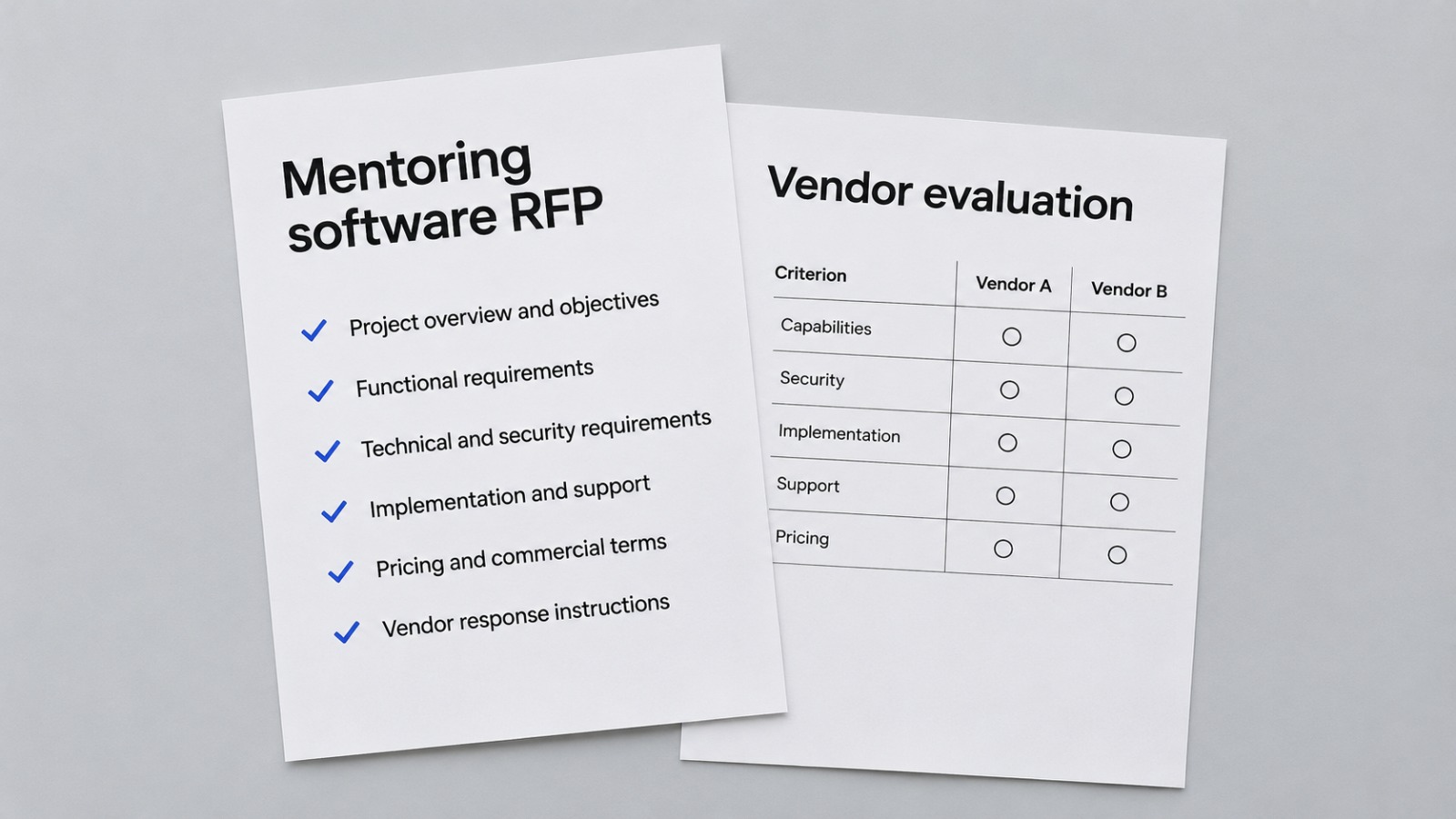
A useful shortlist answers five questions:
- Matching: Who chooses the mentor, and how much control does the administrator retain?
- Participant experience: What helps a pair move from an introduction to a productive conversation?
- Reporting: What can the program owner see, investigate and export?
- Implementation: Who handles setup, data preparation, training and launch communications?
- Cost: What will the complete program cost in its first year and at renewal?
Use the same scenario with every vendor. It makes differences easier to see.
1. Mentorgain
Our first option for structured mentoring with published pricing
Mentorgain is a strong starting point for organizations that want a clear path from matching to ongoing development.
Its mentor matching supports participant exploration and program-assigned pairing. Employees can browse relevant profiles when exploration is enabled, while coordinators can review suggestions and arrange introductions. Program teams can also prioritize available matching fields.
After pairing, mentoring journeys and tasks help participants work toward goals, assign actions and track progress. The reporting and survey features include customizable surveys, dashboards and access to historical data. See how journeys and tasks guide each pair.
Pricing: Mentorgain lists pricing from USD 4,000 annually for up to 100 users on its homepage, with larger user tiers and Enterprise pricing alongside.
Implementation: Mentorgain states that most organizations go live within one to two weeks, depending on customization and user numbers. Treat this as an indicative timeline and confirm your project's requirements.
What to check: Bring your matching criteria and a sample stakeholder report to the demo. Ask to see the complete workflow, including how your team would handle a pairing that needs changing.
2. Together
An option for teams comparing matching criteria and match monitoring
Together deserves a place on the shortlist when you want to weigh your own matching criteria and keep an eye on how matches are going.
Its mentorship platform page describes a pairing algorithm with weighted matching criteria. It also says Together flags matches that are not meeting or have lower session scores, and generates reports on signups, participation, goal completions and session feedback.
Pricing and support: Capterra lists Together pricing starting at USD 10,000 annually for the Professional plan, with Enterprise listed at USD 20,000 annually. Both are listed as flat-rate annual plans. The listing does not specify an allowance of up to 100 users. Confirm participant limits, included support and current terms directly with Together before budgeting.
What to check: Ask how billable active users are defined, whether participants can choose their own mentors, and whether the reports you need are available at your package level. Request a full annual quote covering your participant count and required services.
For a deeper look, read our Mentorgain vs Together comparison.
3. MentorcliQ
An option for organizations comparing enterprise support packages
MentorcliQ is worth reviewing when your buying decision involves several stakeholders and a defined enterprise support requirement.
Its published packages combine Smart Matching, real-time analytics and guided program design. Higher packages add capabilities such as a dedicated success coach, advanced ROI dashboards and custom reports.
Pricing: MentorcliQ pricing starts at USD 9,900 annually for 100 employees. Other packages require custom pricing. Support and reporting vary by package.
What to check: Identify which services your internal team can handle and which need vendor ownership. Then ask for a proposal that explicitly covers program design, participant preparation, launch support and ongoing reviews.
This is especially useful when procurement is comparing packages with similar feature names but different levels of service. A dashboard and a dedicated person helping interpret it are separate buying considerations.
4. Chronus
An option for organizations comparing several matching approaches
Chronus belongs on the shortlist when different programs need different ways of making introductions.
Its matching documentation lists self matching, administrator matching, bulk matching and hybrid matching. Its mentoring software also emphasizes guided conversations, reporting and strategic program support.
Pricing: Contact Chronus for a current proposal.
What to check: Ask the team to demonstrate two programs with different rules. For example, one might let employees select mentors, while another requires administrator approval.
Watch how much configuration each program needs and how the administrator moves between them. That exercise will tell you more about day-to-day suitability than a broad claim about scalability.
Qooper vs Mentorgain: what should buyers focus on?
Compare the complete mentoring workflow and the quoted scope. Both platforms describe matching, participant guidance and reporting. The useful question is how each would handle your program.
For matching, ask both teams to work through the same example: a newly promoted manager seeking support with delegation, feedback and stakeholder communication.
Then follow that relationship through the platform:
- How does the employee explain what they need?
- How does the coordinator review a potential mentor?
- What happens after the introduction?
- How are goals and follow-up actions recorded?
- How does the program owner learn that the pair needs support?
For budget planning, Mentorgain provides a public starting figure, while Qooper requests program details before pricing. That makes Mentorgain easier to include in an initial budget discussion. It does not establish which vendor will offer the lower total price for your requirements.
Ask both vendors for written proposals covering the same participant count, program scope, integrations and services.
How to evaluate matching, reporting and implementation
Test matching with realistic constraints
A convincing demonstration should include an awkward case.
Suppose a mentee needs a mentor outside their reporting line, in a compatible time zone, with experience managing technical teams. Ask the vendor to show how those requirements affect suggestions.
Also ask what happens when there is no suitable match. Your team needs a workable process for that situation, whether it means recruiting more mentors, adjusting capacity or discussing a different development route.
A match score can help organize a review. It cannot guarantee trust, availability or a productive relationship.
Separate participation from development outcomes
Before comparing dashboards, decide what you want to learn.
Participation measures might include enrollment, accepted matches, meetings and survey responses.
Development measures might include progress against agreed goals, confidence in a specific skill or feedback on applying learning at work.
For example, a leadership program could track whether participants practiced delegation and discussed the result with their mentor. Counting meetings alone would miss that detail.
If you intend to connect mentoring with retention or promotion data, ask how the analysis will work. Differences between participants and nonparticipants can reflect several factors. A dashboard should not turn an association into a claim that mentoring caused the result.
Ask who does the implementation work
"Onboarding included" can mean different things.
Request a launch plan that assigns responsibility for participant data, profile questions, matching rules, administrator training and communications. Include any security or integration reviews your organization requires.
The most useful timeline starts with your dependencies. If employee data is incomplete or internal approvals are pending, a vendor's fastest launch example may have little bearing on your project.
Compare the full annual cost
Give every vendor the same brief and ask for an itemized proposal.
Include:
- Participant numbers and how licenses are counted.
- Number and type of programs.
- Implementation and migration services.
- Integrations and sign-on requirements.
- Training and ongoing support.
- Renewal terms and participant growth.
This avoids comparing a basic subscription with a broader service package. It also gives procurement a clearer basis for negotiation.
Questions to ask before switching from Qooper
Changing platforms affects people as well as data. Participants need to know whether their mentor, goals or meeting routine will change.
Before committing, settle three things.
First, decide what needs to move. Participant profiles, active pairings, goals, session records and survey results may have different export and import requirements.
Second, agree on continuity. You may want existing pairs to continue while a new cohort starts on the replacement platform. Ask vendors to explain how they would support that arrangement.
Third, define a successful first month. Choose a few practical checks, such as completed profiles, confirmed pairings and first meetings booked. Use these to assess whether the transition is working.
Do not assume that every field or historical record will transfer automatically. Confirm the migration scope before signing. Our mentoring platform migration guide covers the transition in more detail.
Frequently asked questions
What are the main alternatives to Qooper mentoring software?
Mentorgain, Together, MentorcliQ and Chronus are four options to evaluate. Start with Mentorgain if structured journeys, matching controls and a published starting budget are central to your shortlist. Compare the others against your specific program requirements.
Is Mentorgain cheaper than Qooper?
A like-for-like conclusion requires quotes. Mentorgain publishes a starting price, while Qooper prices according to program requirements. Compare proposals with the same participant count, services and integrations before deciding.
Do Qooper alternatives offer mentor matching and reporting?
Yes. The platforms in this guide describe both capabilities. The differences to investigate are matching controls, participant choice, reporting detail and package availability.
How long does it take to implement mentoring software?
Implementation depends on data readiness, configuration, integrations and internal approvals. Ask for a project plan with named responsibilities and milestones rather than relying only on a general launch estimate.
Can we switch platforms while a mentoring program is running?
Plan around active relationships and confirm what data can transfer. Ask the incoming vendor to demonstrate the migration process and agree on how participants will continue their work during the change.
Start with the program you want to run
The most useful Qooper alternative is the one your team can run well and your employees will keep using.
Start your evaluation with Mentorgain. Bring one real use case, your participant estimate and the questions your leadership team expects the program to answer.
Explore Mentorgain's mentoring software to see how matching, guided journeys and reporting could fit your program.
Related reading
Sources and verification
Product details and pricing were reviewed on November 4, 2026. Vendor claims describe published capabilities and have not been independently tested. Confirm current pricing, package features and participant limits before purchasing.